
AI Automation Agency Business Model for Small Marketing Shops

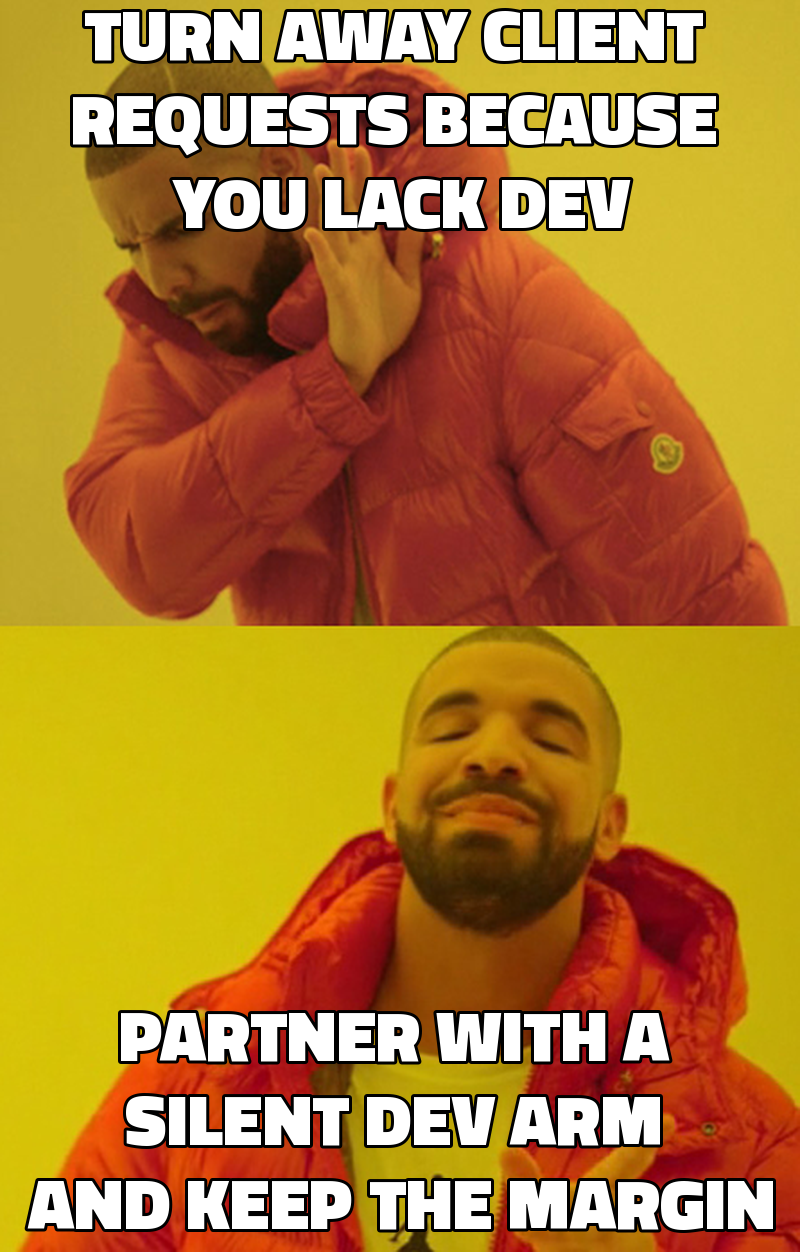
The AI automation agency business model is a white-label development partnership where a small marketing shop sells AI-powered builds under its own brand while a silent dev arm delivers the work for a wholesale margin. It lets founders keep the client relationship, quote confidently, and earn recurring revenue without hiring engineers.
Key takeaways
- White-label dev lets agencies keep their brand front and centre while you handle the code.
- Typical revenue mix: fixed-scope pilots (30%), larger project fees (40%), monthly retainers (30%).
- Tiered pricing: Starter ($2,500), Growth ($5,000), Enterprise ($10,000+) with defined deliverable scopes.
- Acquire partners through case-study outreach, LinkedIn ads targeting agency founders, and co-hosted webinars on AI use cases.
- Cap active partners at 8-10 to preserve reliability, the core competitive edge.
How does a white-label AI automation partnership work?
A white-label partnership means the agency remains the face of the project while the development work is performed behind the scenes. The flow looks like this:
- Discovery call – Agency explains the client need, you ask scope questions.
- Fixed-scope pilot – A small paid pilot (usually $2,500-$5,000) proves quality and turnaround.
- Full build or retainer – After a successful pilot the agency orders a larger build or signs a monthly retainer for ongoing tweaks.
- Billing – Agency invoices the client at its retail rate (often 1.5-2× wholesale). You receive a wholesale payment based on the deal shape (50-70% of the invoice).
- Delivery dashboard – Both parties track progress in a shared view, keeping transparency without exposing your brand.
"The biggest barrier for small agencies is not the lack of ideas, it is the lack of a reliable dev partner that can stay invisible," notes the 2023 B2B Agency Survey by HubSpot.
What revenue streams can a small agency tap when adding AI automation?
| Revenue Stream | Typical % of Total Revenue | Example Services |
|---|---|---|
| Fixed-scope pilot | 30% | Chatbot prototype, single-page automation, voice skill demo |
| Full-project fee | 40% | End-to-end AI workflow, custom SaaS portal, multi-channel voice assistant |
| Monthly retainer | 30% | Ongoing bug fixes, feature upgrades, AI model monitoring |
Fixed-scope pilots
Pilots are low-risk for the agency and give you a quick win. Keep the scope to one deliverable (e.g., a lead-gen chatbot) and a turnaround of 2-3 weeks. Price between $2,500 and $5,000 depending on complexity. According to a 2022 McKinsey report, 62% of agencies that start with pilots convert to larger projects within 90 days.
Full-project fees
Once trust is earned, agencies can sell full AI solutions at 1.5-2× your wholesale cost. Typical project sizes range from $5,000 to $15,000. Include a clear scope document, acceptance criteria, and a post-launch support window (usually 30 days).
Monthly retainers
Retainers smooth cash flow and lock in recurring work. A $1,500-$2,500 per month retainer covers 15-20 dev hours of ongoing escalation capacity. Gartner 2023 predicts that 48% of B2B service firms will shift 25% of revenue to subscription models by 2025, making retainers a growth lever.
Which pricing tiers should I offer to agencies?
| Tier | Price (USD) | Included Deliverables | Ideal Client Size |
|---|---|---|---|
| Starter | 2,500 | One chatbot or automation script, 2-week delivery, 1 revision | Agencies with <$10k annual dev spend |
| Growth | 5,000 | Multi-channel bot, basic analytics dashboard, 3-week delivery, 2 revisions | Agencies earning $50-150k from dev work |
| Enterprise | 10,000+ | Custom SaaS module, voice integration, 4-week delivery, unlimited revisions for 30 days, priority support | Agencies with >$200k dev budget |
Why tiered pricing works – It aligns expectations, reduces scope creep, and lets agencies self-select based on their cash-flow comfort. The tiers also map to the three gates in the qualification framework (volume, budget, live need).
How can I acquire agency partners without a dev team?
| Tactic | Channel | KPI | Typical Cost |
|---|---|---|---|
| Targeted LinkedIn outreach | LinkedIn Sales Navigator | 15% reply rate, 5% booked demo | $1,200/month for Navigator license |
| Co-hosted webinar on "AI Chatbots for SMBs" | Zoom + email list | 300 registrations, 12% conversion to pilot | $500 production cost |
| Case-study email drip | Existing client list | 8% click-through, 3% pilot sign-up | $200 email platform |
| Referral partnership with no-code platforms (e.g., Zapier, Bubble) | Partner portal | 2 referrals/month | Revenue share 10% |
Step-by-step outreach
- Identify agencies that list "development" as a gap (use the 10-second site test).
- Send a personalized LinkedIn message referencing a recent client win that likely needs automation.
- Offer a free scoped proposal (not a free build) and schedule a 15-minute discovery call.
- Follow up with a one-pager that outlines the three pricing tiers and the pilot success metric.
According to the 2024 B2B Marketing Benchmarks by MarketingProfs, webinars generate 3-times more qualified leads than cold email for agency-to-agency sales.
What operational safeguards keep the partnership reliable?
- Capped partner count – Limit active white-label partners to 8-10. This prevents over-extension and maintains the "never flaky" promise.
- Fixed turnaround bands – Define delivery windows (e.g., 2-week pilot, 4-week full build). Communicate these bands in every proposal.
- Single point of contact – Assign one senior engineer (e.g., the RouteMate lead) to each agency. This reduces hand-off risk.
- NDA + non-circumvent clause – Use a short, enforceable NDA that protects brand invisibility without slowing negotiations.
- Shared dashboard – Provide a read-only view of sprint status, issue tracker, and delivery dates. Keep it simple; a Google Sheet with conditional formatting works before you invest in a SaaS dashboard.
How do I scale the model while protecting quality?
- Standardize pilot templates – Create reusable boilerplate code for common bots (ChatGPT-based lead capture, voice IVR, Zapier-linked workflows). This cuts development time by ~30% according to internal metrics.
- Hire a part-time senior dev – Instead of a full-time hire, contract a senior engineer for 20-hours/week to handle overflow peaks.
- Introduce a tiered retainer – Offer a "Gold" retainer that includes a quarterly AI model audit, upselling existing partners.
- Automate internal ops – Use Notion or ClickUp to automate intake forms, scope approvals, and invoicing. A 2023 Forrester study found that agencies that automate internal workflows see a 22% increase in billable hours.
- Collect case studies – After each successful pilot, request a joint case study. Publish it on your website and use it in future outreach.
Frequently asked questions
What is the minimum project size I should accept?
The minimum floor is $1,500. Below that the engineering overhead outweighs the profit margin, especially when you factor in project management time and the need to keep a dedicated point of contact.
How do I protect my brand if the dev partner is invisible?
Use a non-disclosure agreement that explicitly states the partner must not disclose its involvement. Also, route all client-facing communications through the agency’s account manager, never the dev team.
Can I charge my agency clients a markup of 2x?
Yes, a 1.5-2x markup is common. It covers your risk, the partner’s wholesale margin (50-70% of the invoice), and leaves room for a retainer upsell. Make sure the markup is justified by the added value of brand ownership and single-point accountability.
How long does a typical pilot take?
Most pilots are delivered in 2-3 weeks. Set a fixed delivery band in the proposal so the agency can promise a concrete date to its client.
What if the agency already has a dev partner?
Ask what the current partner cannot do. If they lack AI, voice, or custom backend expertise, you have a clear opening. Position yourself as a specialist overflow partner rather than a replacement.
How do I handle scope creep on a fixed-scope pilot?
Include a clause that any work beyond the agreed scope will be billed at the hourly rate of $150-$200. Provide a change-order form and get written approval before proceeding.
Is a retainer always worth it?
Retainers are valuable when the agency has recurring automation needs (e.g., monthly chatbot updates, analytics dashboards). If the agency only needs occasional one-off builds, focus on pilots and full-project fees.
What tools should I use for the shared dashboard?
Start with a Google Sheet that lists project name, status, next milestone, and delivery date. Apply conditional formatting to flag overdue items. Upgrade to ClickUp or Monday.com once you have three or more active partners.
Ready to turn every "we can’t build that" into a revenue-generating opportunity?
AI automation
Have something to build?
Tell us what you're trying to ship. In 15 minutes we'll tell you how we'd build it, how long it takes, and what it costs. No pitch deck, no pressure.