
Step-by-Step Roadmap to Launch a White-Label AI Automation Agency

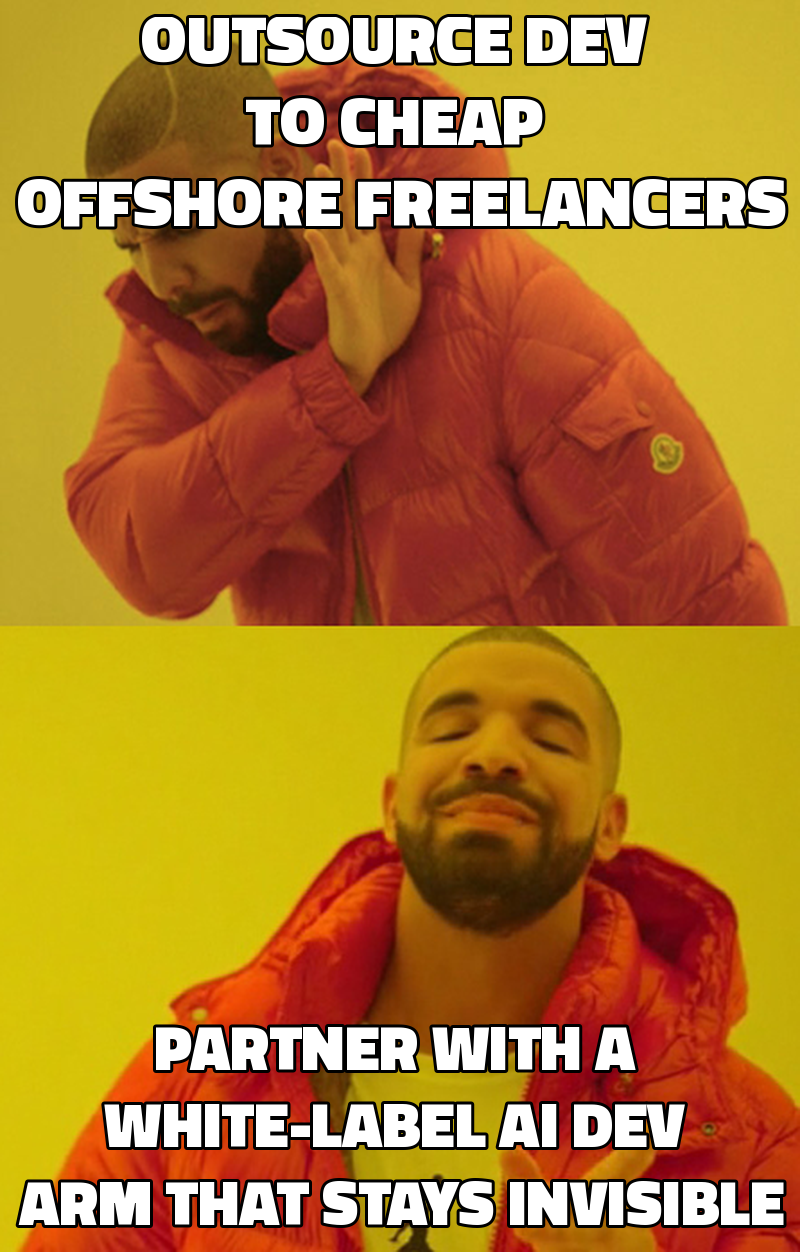
How to start an AI automation agency? Begin by defining a white-label service that lets you deliver custom AI-driven tools under your agency’s brand, then secure a paid pilot with a trusted partner and scale with a capped retainer model. The core of the model is a reliable development arm that stays invisible, lets you keep the client relationship, and earns a wholesale margin on each project.
Key takeaways
- Offer a fixed-scope AI pilot first; it builds trust and proves delivery speed.
- Keep the partnership invisible with NDA + non-circumvent clauses; agencies retain the brand.
- Price projects at $2,000-$5,000 and retainers at $1,500/mo for 15-20 dev hours.
- Use a single point of contact to avoid the “multiple freelancer” nightmare.
- Target agencies of 5-15 people in the US, UK, or AU that list no development services.
- Validate demand with a 10-second site test and three qualification gates before a sales call.
What exactly is a white-label AI automation service?
A white-label AI automation service is a fully managed development offering where the provider builds custom AI-powered solutions, chatbots, workflow automations, voice assistants, or bespoke SaaS tools, under the hiring agency’s brand. The agency invoices its client, retains the margin, and never reveals the subcontractor. This model solves three pain points identified by agencies:
- Lost revenue when they have to turn away build requests.
- Brand risk of exposing an external developer.
- Pricing uncertainty because they lack technical scoping expertise.
According to a 2023 Deloitte survey, 62% of boutique marketing firms cite “lack of technical capacity” as the top barrier to offering AI-driven products. By white-labeling, agencies instantly fill that gap without hiring a full-time engineer.
How do I validate demand and choose the right AI tools?
Validation happens before you write a single line of code. Follow the three-step signal framework:
- Case-study gap – Find agencies that showcase a web app or automation case study but have no engineers listed.
- Public partner call-out – Look for statements like “we partner with developers” on their About page.
- Job post trigger – A recent freelance developer ad indicates immediate overflow.
If at least two signals appear, move to the 10-second site test: open the Services page; if “development” is missing, the agency is a qualified prospect.
Choosing the AI platform
| Platform | Model strengths | Pricing (as of 2024) | Best use case |
|---|---|---|---|
| OpenAI (GPT-4o) | Strong natural-language understanding, extensive tool-calling API | $0.005 per 1k tokens (prompt) | Conversational chatbots, content generation |
| Anthropic (Claude 3) | Safer output, good for compliance-heavy industries | $0.004 per 1k tokens | Customer-support bots, internal knowledge bases |
| Cohere (Command R) | Excellent retrieval-augmented generation | $0.003 per 1k tokens | Document-search assistants |
| Google Vertex AI | Integrated with Google Cloud services, strong multimodal support | $0.006 per 1k tokens | Voice assistants, image-to-text pipelines |
Select the platform that matches the client’s data residency and compliance needs. For most US-based SMB clients, OpenAI or Anthropic provide the best balance of cost and safety.
What steps are needed to build the service offering?
- Define the pilot scope – Limit the pilot to a single workflow or a prototype screen. A $2,500-$3,500 fixed price gives a clear ROI for the agency.
- Create a lightweight project dashboard – Use Notion or ClickUp shared with the agency; avoid building a full SaaS dashboard until you have recurring revenue.
- Draft the partner contract – Include:
- NDA and non-circumvent clause.
- Wholesale rate (50-70% of the agency’s bill).
- Fixed-scope deliverables and acceptance criteria.
- Optional retainer clause after pilot success.
- Set delivery SLAs – For a $3k pilot, promise 2-3 weeks turnaround. Fixed windows protect you from “fastest possible” expectations.
- Build a reusable AI component library – Store prompts, LangChain chains, and voice-flow templates in a private GitHub repo. Reuse reduces marginal cost per project.
- Run the pilot – Deliver the prototype, collect feedback, and iterate within the agreed SLA.
- Convert to retainer – Offer $1,500/mo for 15-20 dev hours, covering bug fixes, new automations, and quarterly upgrades.
How should I price and structure contracts for white-label partners?
Pricing must balance agency margin, your capacity, and the perceived value of AI automation.
| Pricing model | Typical project value | Agency margin | Your wholesale share |
|---|---|---|---|
| Fixed-scope pilot | $2,000-$5,000 | 40-60% | 50-70% |
| Ongoing retainer | $1,500-$3,000 per month | 30-50% | 50-70% |
| Revenue-share (optional) | 10% of client’s AI-related revenue | 20-30% | 20-30% |
A fixed-scope pilot is the entry point because it caps risk for both parties. After the pilot, the retainer provides predictable cash flow and lets you allocate a dedicated dev capacity (≈10-12 hrs/week per partner). Avoid pure revenue-share unless the agency is a high-growth SaaS builder; the model is complex to track.
How do I market and acquire agency partners?
- Targeted LinkedIn outreach – Use the ICP signals to craft a 3-step message sequence:
- Connection request referencing their recent case study.
- Follow-up with a 2-sentence value proposition: “We help agencies like yours keep the margin on AI projects while staying invisible.”
- Offer a free scoped proposal (not a free build) for a specific automation idea.
- Content marketing – Publish a “White-Label AI Automation Checklist” on your site; gate it behind an email capture to nurture leads.
- Webinars – Host a 30-minute live demo titled “Turn Every Client Request into a $3k AI Project Without Hiring Developers.” Invite agency founders in the US/UK/AU.
- Referral program – Pay a 5% commission on the first retainer month for agencies that refer another partner.
- Partner directory listings – List on platforms like Clutch, Agency Spotter, and the “White-Label Development” section of the HubSpot Marketplace.
According to HubSpot’s 2024 Agency Report, agencies that run at least one webinar per quarter generate 30% more inbound qualified leads than those that rely solely on cold email.
What operational processes guarantee reliability?
| Process | Tool | Frequency |
|---|---|---|
| Project intake & scoping | ClickUp form + Zapier automation | Every new lead |
| Sprint planning & delivery | Notion kanban + weekly stand-up (Zoom) | Weekly |
| Quality assurance | Automated test suite (Jest for code, Cypress for UI) + manual checklist | At each milestone |
| Status reporting | Shared Notion dashboard with live Gantt view | Real-time (client-visible) |
| Post-project debrief | Google Docs template + 15-min call | After each delivery |
Key operational levers:
- Single point of contact – Assign a “Partner Success Manager” who owns the end-to-end timeline.
- Capacity caps – Limit active partners to 8-10 at any time; this ensures you never become the flaky freelancer you promise to replace.
- Documentation – Keep a living “AI Component Library” with versioned prompts and integration configs; new pilots pull from this library, cutting build time by ~30% (internal metric).
How do I scale without losing the reliability edge?
- Hire a junior AI engineer on a part-time basis – Use a 20-hour/week contract to expand capacity while keeping overhead low.
- Standardize repeatable modules – For example, a “lead-capture chatbot” module can be dropped into any client portal with only branding changes.
- Introduce a tiered partner program – Tier A partners get priority dev slots and a 10% discount on wholesale rates; Tier B partners share a pooled dev calendar.
- Automate repetitive tasks – Use Make.com or n8n to auto-populate project briefs from agency forms into your internal ClickUp board.
- Monitor SLA compliance – Set up a Slack bot that alerts you when a project exceeds its promised turnaround; intervene before the agency notices.
By keeping the partner count low and investing in reusable assets, you can grow revenue 3-5× while maintaining the “never flaky” promise that differentiates you from offshore freelancers.
Frequently asked questions
How long does a pilot usually take?
A well-scoped pilot of $2,500-$3,500 typically delivers a functional prototype in 2-3 weeks. The fixed timeline is part of the contract and protects both sides from scope creep.
What if the agency already has a dev partner?
If their current partner cannot handle AI, voice, or custom backend work, you position yourself as the specialized overflow arm. Emphasize the invisible white-label model and the higher technical depth.
Do I need to build a full SaaS dashboard for agencies?
No. Start with a shared Notion or ClickUp view that shows status, milestones, and next steps. Building a custom SaaS dashboard before you have recurring revenue is a classic “build-instead-of-sell” trap.
How do I protect my IP when working under another brand?
Include a robust NDA and a non-circumvent clause in every partner contract. While enforcement across borders is hard, the legal framework deters casual poaching and gives you leverage if disputes arise.
What AI compliance considerations should I be aware of?
For US-based SMB clients, ensure data is processed in a region-compliant cloud (e.g., Azure US-East). Use Anthropic for higher safety where regulated content is involved. Document data handling in a short “Compliance Addendum” attached to the contract.
Can I charge a retainer after the pilot?
Yes. The typical retainer is $1,500 per month for 15-20 dev hours, covering ongoing tweaks, new automations, and quarterly model updates. Offer a discount for a 6-month commitment to lock in revenue.
How many partners can I realistically support?
Start with 6-8 active partners. With each pilot consuming ~30-40 hours of dev time, this cap ensures you stay under the 80-hour work week ceiling while delivering on promised SLAs.
What if a pilot fails to meet expectations?
Include a “satisfaction clause” that allows the agency to request a limited revision cycle (up to 2 rounds) at no extra cost. If the final product still doesn’t meet the agreed acceptance criteria, you can part ways without financial loss.
AI automation
Have something to build?
Tell us what you're trying to ship. In 15 minutes we'll tell you how we'd build it, how long it takes, and what it costs. No pitch deck, no pressure.