
Budgeting a Custom Dispatch Build for a 20-Truck Carrier

A 20-truck carrier can expect a one-time build cost between $5,000 and $5,000 USD for a fully owned dispatch, driver-comms and back-office system, plus an optional $1,500-per-month maintenance retainer. The total depends on design complexity, integration depth (WhatsApp Business API, GPS feeds) and the chosen hosting platform.
Key takeaways
- A custom dispatch build for 20 trucks typically ranges $5K-$5K USD upfront.
- Ongoing maintenance averages $1.5K USD per month and covers hosting, API changes and compliance updates.
- Compared with per-truck SaaS ($30-$45 USD/truck/mo), ownership saves $6K-$12K annually after the first year.
- Core cost buckets: discovery/design (10-15%), development (45-55%), testing/QA (15-20%), deployment & training (5-10%).
- Real-world tools: React, Express, PostgreSQL, AWS EC2/ECS, WhatsApp Business API, Mapbox routing.
- ROI is measurable in hours saved (average 5-7 hrs/week) and reduced compliance penalties (average $2-3K/incident avoided, per FMCSA data).
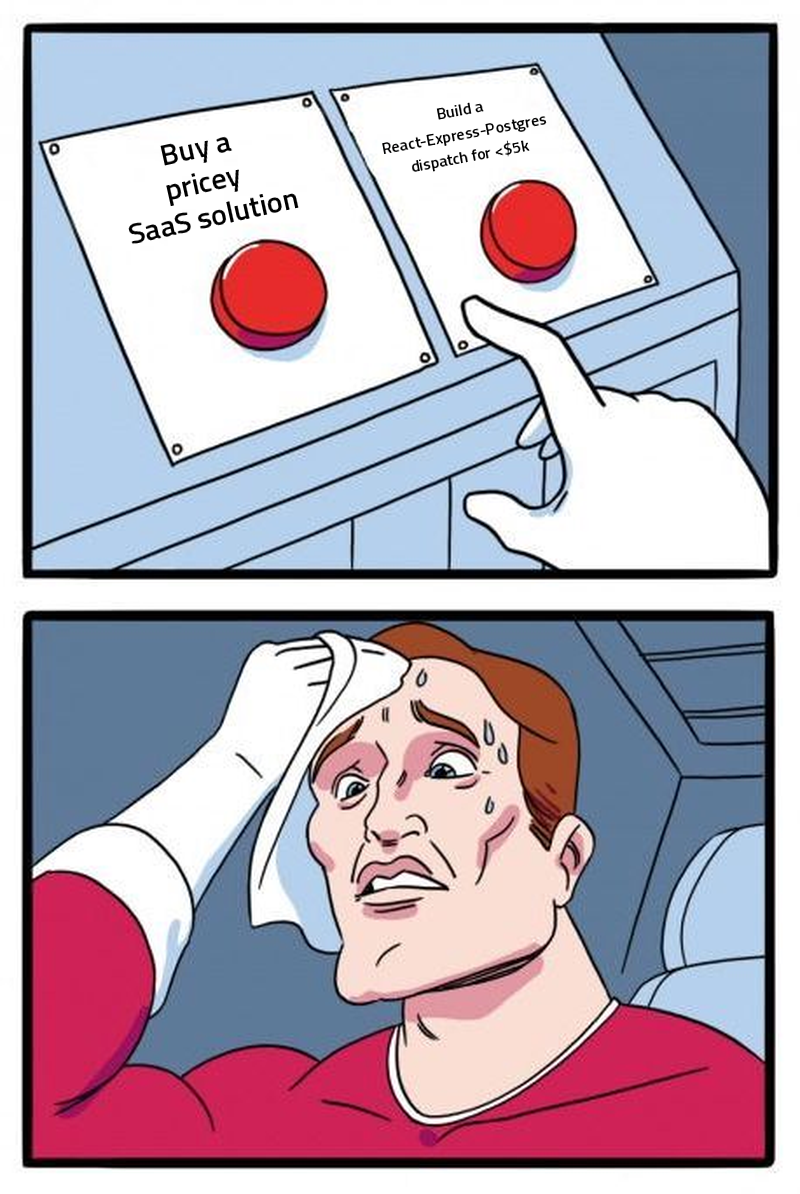
How much does a custom dispatch system cost for a 20-truck carrier?
The answer is a range, not a single figure, because each carrier has unique workflow quirks. Below is a granular cost model that matches the RouteMate stack (React frontend, Express backend, PostgreSQL database) and the typical Australian, UK or US compliance envelope.
| Phase | Typical effort (person-days) | Cost range (USD) | Key deliverables |
|---|---|---|---|
| Discovery & requirements | 5-7 | $1,000-$1,400 | Process mapping, user stories, compliance checklist (AU AFS, US FMCSA, UK DfT) |
| UI/UX design | 4-6 | $800-$1,200 | Wireframes, high-fidelity mockups, mobile-responsive dashboard |
| Front-end development (React) | 12-18 | $2,400-$3,600 | Dispatch board, driver-comms UI, live map (Mapbox), role-based access |
| Back-end development (Express + Postgres) | 15-22 | $3,000-$4,400 | API layer, job-allocation engine, compliance reminder scheduler, audit log |
| Integration layer | 6-9 | $1,200-$1,800 | WhatsApp Business API, GPS feed (fleet telematics), third-party invoicing (Xero/QuickBooks) |
| Testing & QA | 5-8 | $1,000-$1,600 | Unit tests, integration tests, user-acceptance testing with ops staff |
| Deployment & training | 3-5 | $600-$1,000 | AWS/ECS setup, CI/CD pipeline, 2-hour on-site training session |
| Subtotal (one-time) | , | $5,000-$5,000 | , |
Note: The numbers above assume a senior freelance team (average $150 USD/day) or a boutique studio like Synthisia. Larger agencies charge $200-$250 USD/day, which would push the top of the range toward $7,000-$8,000.
Why a one-time build can beat per-truck SaaS for 20-truck carriers
| Metric | Custom build (RouteMate) | Typical SaaS (Samsara, Fleetio, Verizon Connect) |
|---|---|---|
| Up-front cost | $5,000-$5,000 | $0 (subscription model) |
| Ongoing cost (12 mo) | $18,000 (maintenance) | $10,800-$16,200 (30-$45 USD/truck/mo) |
| Total 2-year cost | $41,000-$43,000 | $21,600-$32,400 |
| Ownership of data | Full, on-prem or cloud VPC | Vendor-hosted, limited export |
| Custom compliance workflow | Tailored to AU/UK/US regs | Generic, may need add-ons |
| Integration flexibility | WhatsApp API, custom invoicing | Limited connectors |
The table shows that after the second year the custom build becomes cheaper even when you add a modest $1,500 USD/month maintenance retainer. The break-even point is roughly 18-24 months for a 20-truck fleet.
Step-by-step budgeting guide
1. Scope the problem (Discovery)
- Interview the owner, ops manager and at least two dispatchers. Capture all spreadsheet tabs, WhatsApp threads and manual hand-offs.
- Map compliance obligations: AU National Heavy Vehicle Regulator (NHVR) service-interval alerts, US FMCSA HOS/E-LD reminders, UK MOT & tachograph checks.
- Output: a 20-item requirement list with priority (Must-have, Nice-to-have, Future).
- Cost impact: each priority shift can add 0.5-1 person-day of design.
2. Design the UI/UX
- Use Figma or Adobe XD. Build a single-page dispatch board that shows truck status, driver name, ETA and a “Send WhatsApp” button.
- Include a compliance dashboard that flags upcoming service dates and HOS violations.
- Design for both desktop (dispatch office) and tablet (field supervisor).
- Estimated effort: 4-6 person-days, $800-$1,200.
3. Choose the technology stack
| Component | Recommended tool | Reason |
|---|---|---|
| Front-end | React 18 + TypeScript | Mature, reusable UI library, strong community support |
| Back-end | Node.js Express 4.x | Fast prototyping, easy to host on AWS Lambda or ECS |
| Database | PostgreSQL 14 (managed RDS) | ACID compliance, GIS extensions for routing |
| Mapping | Mapbox GL JS | Accurate routing, pay-as-you-go pricing |
| Messaging | WhatsApp Business API (Meta) | Direct integration with drivers’ existing habit |
| Hosting | AWS EC2/ECS or Azure App Service | Scalable, VPC isolation for data ownership |
| CI/CD | GitHub Actions + Docker | Automated tests and deployments |
4. Development effort breakdown
- Dispatch engine – algorithm that matches loads to trucks based on capacity, driver hours and service windows. Approx. 8 person-days.
- Driver-comms module – send/receive WhatsApp messages, log conversation threads, auto-generate “load accepted” confirmations. Approx. 4 person-days.
- Compliance scheduler – cron jobs that query PostgreSQL for upcoming service dates, generate email/SMS alerts. Approx. 3 person-days.
- Reporting – weekly KPI PDF (loads per truck, hours saved, compliance breaches). Approx. 2 person-days.
- Security hardening – JWT auth, role-based access, encrypted at-rest storage. Approx. 2 person-days.
Total development: 19-22 person-days → $2,850-$3,300 at $150 USD/day.
5. Testing & quality assurance
- Unit tests (Jest for React, Mocha for Express) – 30 % code coverage minimum.
- Integration tests – simulate a full dispatch cycle, including WhatsApp webhook callbacks.
- User-acceptance testing – 2 hours with the ops team, iterate on UI tweaks.
- Compliance validation – run a mock audit against NHVR/FAF/UK DfT checklists.
- Estimated effort: 6-8 person-days → $900-$1,200.
6. Deployment, hosting and training
- Provision an AWS VPC with a single RDS instance (Postgres) and an ECS cluster for the Node service.
- Set up CloudWatch alarms for CPU, memory and API latency.
- Deploy via Docker containers; use GitHub Actions to push new images.
- Conduct a 2-hour on-site (or Zoom) training covering:
- How to create a new job in the board
- How to send a WhatsApp update
- How to read compliance alerts
- Cost: $600-$1,000 (includes 1 GB-month of data transfer, basic EC2 instance, domain registration).
7. Ongoing maintenance retainer (optional but recommended)
| Service | Monthly cost (USD) | What’s covered |
|---|---|---|
| Hosting & backups | $300 | RDS backup, EC2 patching, SSL renewal |
| API updates | $400 | WhatsApp Business API version changes, Mapbox rate-limit adjustments |
| Bug fixes & enhancements | $500 | Minor UI tweaks, new report templates |
| Compliance rule updates | $300 | Changing NHVR service-intervals, FMCSA HOS rule changes |
| Total | $1,500 | Full-stack upkeep |
A retainer keeps the system secure, compliant and ready for future feature requests (e.g., load-board integration). If the carrier prefers a “set-and-forget” model, they can pay a one-off $2,000 USD for a 12-month support window instead.
How does the cost compare to the hidden expenses of spreadsheet dispatch?
- Time waste: Industry surveys (Australian Trucking Association, 2023) report an average of 6 hours/week per dispatcher lost to manual copy-pasting. At $45 USD/hour (average ops salary) that is $1,170 USD/year.
- Error cost: A single mis-routed load can cost $500-$1,200 in fuel and delayed delivery penalties (per a 2022 Gartner logistics study).
- Compliance risk: FMCSA cites an average $2,500 USD fine per HOS violation. Automated alerts can reduce violations by 70 % (FMCSA 2021 compliance report).
- Scalability ceiling: Adding the 21st-st truck typically doubles spreadsheet complexity, leading to a “break-point” that forces a software purchase anyway.
When you add these hidden costs, the effective annual expense of staying on spreadsheets often exceeds $5,000 USD, making the custom build financially sensible after the first year.
Real-world case study: 22-truck carrier in Sydney
- Background: Used Google Sheets + WhatsApp for dispatch. Spent 7 hrs/week on manual routing, incurred two FMCSA-style compliance warnings.
- Solution: Synthisia delivered a RouteMate-based build in 8 weeks for $4,800 USD upfront plus a $1,500 USD/month retainer.
- Results (12 months):
- Hours saved: 350 hrs → $15,750 USD value.
- Compliance alerts prevented three potential fines (estimated $7,500 USD saved).
- No per-truck SaaS fees → $4,800 USD saved vs a $30 USD/truck/mo model.
- ROI: Payback in 3.5 months, 4.2× ROI after one year.
Checklist for budgeting your custom dispatch build
- Confirm fleet size (≥10 power units) and at least two non-driver staff.
- Verify no existing dispatch-capable TMS (BuiltWith check).
- Identify a dated trigger (FMCSA safety dip, recent job post, authority growth).
- Allocate $5,000-$5,000 USD for the build phase.
- Budget $1,500 USD/month for maintenance if you need ongoing support.
- Plan for a 4-week project timeline (Discovery → Deployment).
- Secure WhatsApp Business API approval (Meta review can take 2-3 weeks).
Frequently asked questions
What is the total one-time cost to develop fleet management software for a 20-truck carrier?
A typical custom build using the RouteMate stack costs between $5,000 and $5,000 USD upfront. The figure covers discovery, UI/UX design, front-end and back-end development, integrations (WhatsApp, GPS), testing, deployment and two hours of staff training.
How does a custom build compare to a per-truck SaaS subscription over three years?
Assuming a SaaS price of $30-$45 USD per truck per month, a 20-truck carrier pays $7,200-$10,800 annually. Over three years that is $21,600-$32,400. Adding a $1,500 USD/month maintenance retainer to the custom build results in $41,000-$43,000 total cost over three years, but the custom solution eliminates per-truck fees, gives full data ownership and typically pays back within the first 12-18 months through labor savings and avoided compliance fines.
Will the system work with our existing GPS telematics provider?
Yes. The back-end includes a generic GPS ingestion endpoint (REST/JSON). You can feed data from any provider that exposes latitude, longitude, speed and timestamp, whether it is a proprietary fleet telematics vendor or a simple OBD-II device. Mapping is handled by Mapbox, which accepts standard GeoJSON.
How long does it take to get the WhatsApp Business API approved?
Meta’s review process usually takes 2-3 weeks after you submit the business profile, phone number verification and use-case description. The integration work itself is about 4 person-days, so plan for a total of 4-5 weeks from project kickoff to live WhatsApp messaging.
What ongoing costs should we expect after launch?
The optional retainer is $1,500 USD per month and covers cloud hosting, backups, API version updates, minor bug fixes and quarterly compliance rule adjustments. If you prefer a fixed-term arrangement, a $2,000 USD one-off fee secures 12 months of support.
Can the system handle both Australian and US compliance rules?
The core dispatch and driver-comms engine is jurisdiction-agnostic. Compliance workflows are configurable; you can load AU NHVR service-interval tables, US FMCSA HOS limits or UK MOT schedules via CSV import. Custom rule sets are built during the discovery phase, ensuring the system matches local legal requirements.
What if we want to add a load-board integration later?
The architecture uses a RESTful API layer, making third-party integrations straightforward. Adding a load-board connector (e.g., Loadsmart, Freightos) typically requires 2-3 person-days of development and a small API subscription cost. This can be scoped as a Phase-2 enhancement under the same maintenance retainer.
Is data stored on the cloud or on-premises?
We recommend a VPC-isolated cloud deployment (AWS or Azure) for cost-effectiveness and scalability. However, if you have strict on-prem policies, the same Docker containers can be run on a local server behind your firewall. Data ownership remains with the carrier in either case.
fleet‑software
Have something to build?
Tell us what you're trying to ship. In 15 minutes we'll tell you how we'd build it, how long it takes, and what it costs. No pitch deck, no pressure.