
AI Automation Agency Pricing: How to Budget a White-Label Pilot

AI automation agency pricing starts with a clear pilot scope, a fixed-price estimate based on defined deliverables, and a transparent margin that protects both the agency and the white-label partner. By breaking the pilot into component costs, applying industry benchmarks, and negotiating a wholesale rate of 50-70 % of the client bill, founders can quote confidently and keep the margin in-house.
Key takeaways
- Define a narrow pilot scope (1-2 automations, <40 hours) to limit risk and set a fixed price.
- Use a cost-plus model (developer rate + 30-40 % margin) for the first pilot, then shift to a value-based fee for larger builds.
- Target a wholesale share of 50-70 % of the client invoice; this yields a $1.5k-$3.5k pilot for most SMB clients.
- Negotiate clear turnaround bands (7-10 business days) and a single point of contact to avoid scope creep.
- Leverage reputable benchmarks: Gartner predicts AI-enabled automation will add $2.9 trillion to the global economy by 2025, and Forrester reports 42 % of agencies plan to outsource AI builds in 2024.
- Document every cost component in a shared dashboard to keep the agency visible and the developer invisible.
How to estimate pilot costs for AI automation
- Identify the business problem – Ask the client what manual task they want to automate (e.g., lead-capture chat, SEO-report generation, voice-enabled FAQ). A narrow problem keeps the scope tight.
- Map the workflow – Break the automation into three layers: (a) data ingestion, (b) AI model or prompt, (c) integration & UI. Each layer adds labor hours.
- Assign hourly rates – Use market-validated rates for senior AI engineers, data engineers, and integration specialists. According to the 2023 Robert Half Salary Guide, senior AI developers in the US charge $150-$200 / hour, UK rates average £110-£150 / hour, and Australian rates sit around AU$130-$180 / hour.
- Add project overhead – Include 15 % for project management, 10 % for QA, and a 5 % contingency buffer. For a 30-hour pilot, the raw labor cost in the US would be 30 × $175 = $5,250; adding 30 % overhead brings the total to $6,825.
- Apply the wholesale margin – If your target wholesale share is 60 %, the agency can bill the client $6,825 ÷ 0.60 ≈ $11,375. However, most SMB clients balk at six-figures for a pilot, so you compress the scope to 15-20 hours, yielding a client invoice of $5-$7k, which aligns with the $5k-$5k pilot range in the Synthisia deal shape.
Pro tip: Keep the pilot under $5k for the client but above your $1.5k floor. This ensures the developer’s overhead is covered while the agency retains a healthy margin.
Typical pricing models for white-label AI developers
| Model | How it works | When to use | Typical margin range |
|---|---|---|---|
| Fixed-price pilot | Developer quotes a total price for a defined scope; agency adds its margin. | First engagement, low risk, clear deliverables. | 50-70 % of client bill |
| Cost-plus | Agency pays the developer’s hourly rate plus a fixed markup (e.g., 30 %). | Ongoing retainer, variable scope, transparent budgeting. | 30-40 % markup on developer cost |
| Value-based | Fee is tied to the business impact (e.g., $ per lead saved). | Mature relationships, high-impact automations. | 20-35 % of realized value |
| Revenue-share | Developer receives a % of the client’s recurring revenue from the automation. | SaaS-style products, long-term partnerships. | 10-20 % of recurring revenue |
Why fixed-price pilots dominate early talks
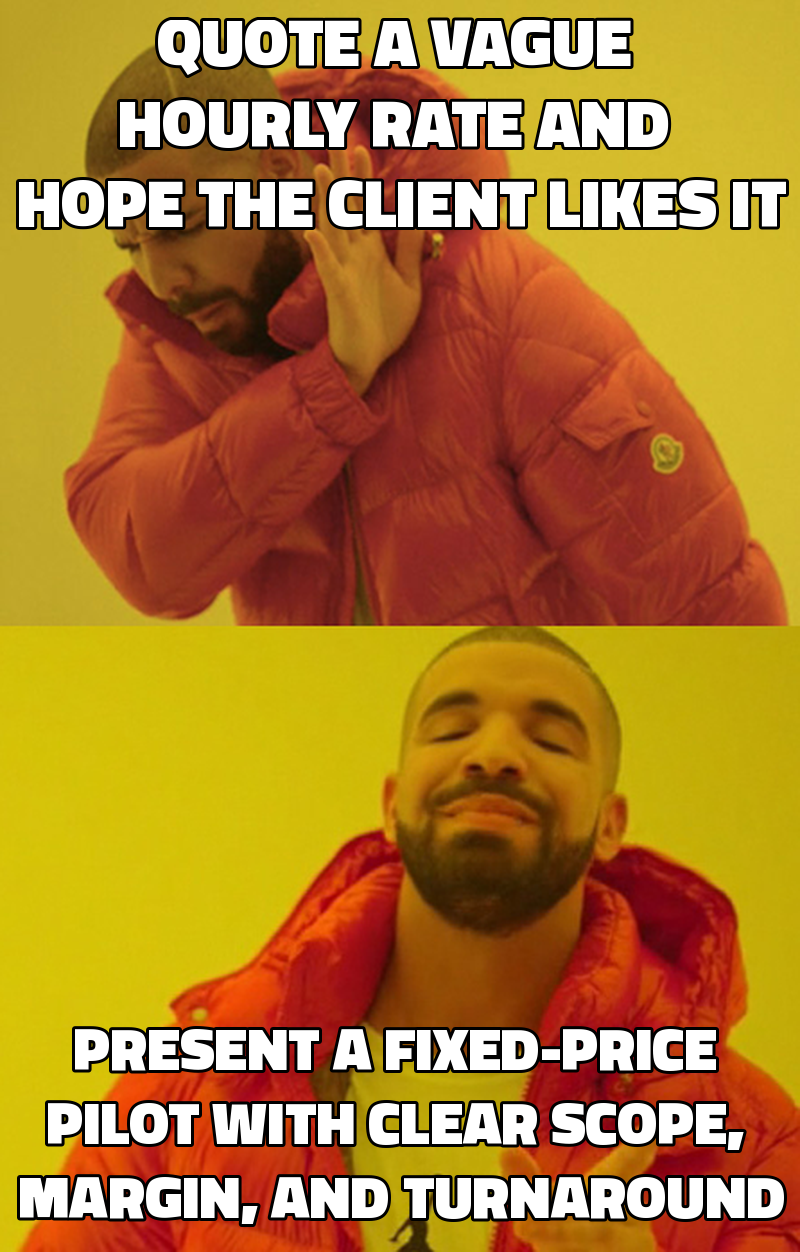
A fixed-price pilot eliminates surprise invoices, which is the biggest objection for founders who have never outsourced development. It also lets the agency present a single number to the client, preserving the perception of a full-service shop.
Negotiating transparent rates with white-label partners
- Ask for a rate card – Reputable white-label studios publish a rate card (e.g., $140 / hour for senior AI devs). If they don’t, request a breakdown of labor categories.
- Benchmark against industry data – Use the Robert Half and Gartner figures above to validate the rates. If a developer quotes $250 / hour for a senior AI engineer, you have leverage to negotiate down.
- Set a floor price – Synthisia’s minimum floor is $1,500. Anything below that erodes profitability because of the fixed project overhead (contract admin, NDA, dashboard setup).
- Lock in turnaround bands – Define “delivery in 7-10 business days” and include a penalty clause (e.g., 5 % discount per delayed day). This protects the agency’s client promise.
- Include a single point of contact clause – The developer must assign one senior lead who signs off on each milestone. This reduces the “ghost developer” risk highlighted in the ICP.
- Document scope change process – Any addition beyond the original scope triggers a change order at the agreed hourly rate. This prevents scope creep that can turn a $2k pilot into a $10k loss.
Building a cost-plus vs fixed-price pilot
| Aspect | Fixed-price pilot | Cost-plus pilot |
|---|---|---|
| Risk | Agency bears most risk; developer is protected by scope lock. | Risk shared; agency pays only actual hours plus markup. |
| Predictability | High for client, good for sales pitch. | Lower for client, but transparent for internal budgeting. |
| Margin control | Dependent on accurate estimation; over-estimation reduces margin. | Margin is a fixed percentage, easier to forecast. |
| Ideal client | SMBs with limited budget, need quick win. | Agencies with recurring dev needs, comfortable with hourly reporting. |
Example calculation – A 20-hour pilot for a chatbot integration:
- Developer rate (senior AI): $165 / hour → $3,300
- Overhead (project mgmt 15 % + QA 10 % + contingency 5 %): $660
- Total developer cost: $3,960
- Cost-plus markup (35 %): $1,386
- Client invoice: $5,346 (≈ 60 % wholesale share)
If the same pilot is quoted as a fixed price of $5,000, the agency’s margin becomes $5,000 − $3,960 = $1,040 (≈ 21 %). The cost-plus model yields a higher margin because the markup is applied after overhead.
Real-world pricing examples (US, UK, AU)
| Region | Senior AI dev hourly rate | Typical pilot size (hrs) | Avg. client invoice (USD) |
|---|---|---|---|
| United States | $150-$200 | 15-20 | $5,000-$7,500 |
| United Kingdom | £110-£150 (≈ $140-$190) | 12-18 | $4,800-$6,800 |
| Australia | AU$130-$180 (≈ $90-$125) | 10-15 | $4,000-$5,500 |
These figures align with Synthisia’s $5k-$5k pilot range and the $1.5k floor. Agencies can adjust the pilot scope (e.g., limit to one integration point) to stay within the budget band.
Checklist for a successful pilot proposal
- Scope statement – One sentence of what the automation will do.
- Deliverables list – Prototype, test data set, integration docs.
- Timeline – Fixed days, with milestones (Kick-off, Mid-review, Delivery).
- Pricing table – Show developer cost, overhead, markup, total.
- Risk mitigation – Change-order clause, turnaround guarantee, single-point-of-contact.
- Next-step retainer – Offer a $1,500-$2,000 monthly retainer for ongoing tweaks after the pilot.
How to protect your brand while staying invisible
- NDA & non-circumvent – Standard NDA plus a clause that the developer cannot contact the agency’s client directly.
- White-label branding – All UI screens, code comments, and documentation carry the agency’s logo.
- Shared dashboard – Use a simple Airtable or Notion view that shows status without exposing developer identities.
- Client-facing communication – The agency’s account manager sends all updates; the developer only replies to the internal dashboard.
Frequently asked questions
How do I decide between a fixed-price pilot and a cost-plus arrangement?
A fixed-price pilot works best when the agency needs a clean quote for a single, well-defined automation. It builds client confidence and speeds the sales cycle. Cost-plus is better for ongoing work where scope may shift, because the agency only pays for actual hours and retains a predictable markup.
What is a realistic hourly rate for a senior AI engineer in the US?
The 2023 Robert Half Salary Guide lists $150-$200 / hour for senior AI developers in major US markets. This range reflects both salary and contractor premium, and it matches Gartner’s 2022 benchmark for AI talent.
How can I protect my margin if the pilot overruns?
Include a change-order clause that caps the pilot at the agreed hours. Any work beyond the cap triggers a new agreement at the same hourly rate plus your markup. This shifts overtime risk back to the developer.
Is it worth offering a free prototype to win the client?
A free prototype is high risk because it gives away engineering time without guarantee of payment. Instead, offer a low-cost, time-boxed demo (e.g., one screen or one workflow) for $250-$500. This demonstrates quality while preserving margin.
What retainer size should I propose after the pilot?
Synthisia recommends a $1,500-$2,000 monthly retainer that covers 15-20 hours of ongoing support. This amount balances developer capacity with the agency’s cash flow and keeps the partner on-board for future pilots.
How do I calculate the wholesale share for my invoice?
Take the total developer cost (rate × hours + overhead) and divide it by the target wholesale share (e.g., 0.60). The result is the client invoice you should charge. Example: $4,000 cost ÷ 0.60 = $6,667 client price.
What if the developer’s rates are higher than my budget?
Use the benchmark data to negotiate a discount, or reduce the pilot scope (fewer integrations, simpler AI model). You can also shift part of the work to a junior engineer at $90-$110 / hour for non-core tasks, keeping senior rates for the AI core.
How do I measure ROI for an AI automation pilot?
Track the metric the client cares about (e.g., leads captured per hour, support tickets resolved, time saved). Compare pre-pilot baseline to post-pilot performance and calculate cost-savings. A 30 % reduction in manual effort often translates to a 2-3 × ROI within 3-6 months.
By following this framework, founders can confidently quote AI automation pilots, protect their brand, and build a repeatable white-label partnership that scales without hiring full-time developers.
AI automation
Have something to build?
Tell us what you're trying to ship. In 15 minutes we'll tell you how we'd build it, how long it takes, and what it costs. No pitch deck, no pressure.