
Best TMS Software for Carriers: Custom Solutions Over Generic Tools (2026)

The best TMS for carriers is the one that fits your specific dispatch workflow, compliance needs and budget, whether that means an off-the-shelf SaaS, a local agency build, a freelancer prototype, or a fully owned custom solution. Start by evaluating data residency, regulatory reporting, per-truck cost versus one-time build cost, and how much you want to control the feature roadmap.
Key takeaways
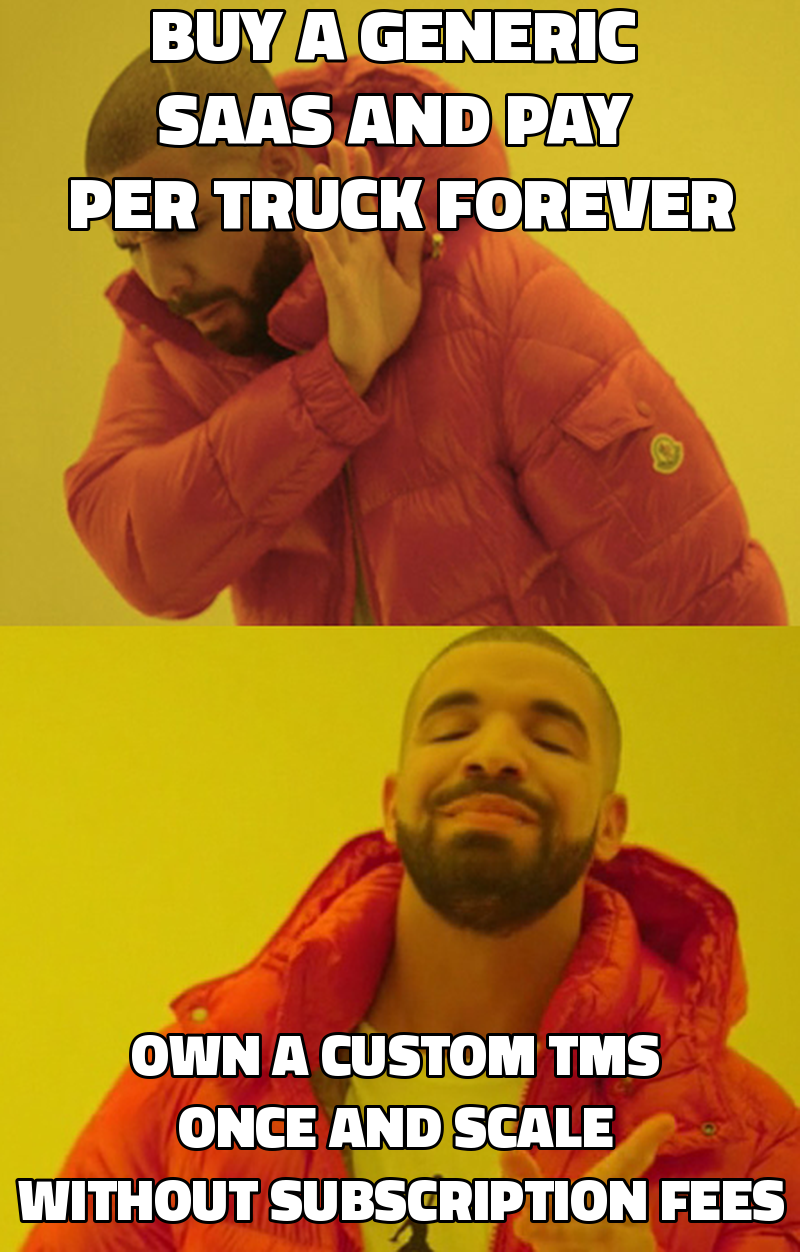
- Off-the-shelf SaaS is quick to start but adds a per-truck subscription that scales with fleet size.
- Local agencies can tailor a solution but often charge high hourly rates and retain ownership of the code.
- Freelancers offer low-cost prototypes; quality and long-term support can be unpredictable.
- A custom/white-label build gives you full ownership, a one-time cost, and the ability to embed region-specific compliance rules.
- Data residency, language support and integration with WhatsApp Business API are critical for AU, UK and US carriers.
- Remote partners that understand freight logistics can deliver faster than a generic software house.
How to compare the main option categories
| Option category | Typical cost model | Ownership of code | Speed to launch | Compliance fit (AU/UK/US) | Scalability | Ongoing support |
|---|---|---|---|---|---|---|
| Off-the-shelf SaaS | Subscription per truck (USD/AUD/GBP) | Vendor retains | Days to weeks | Vendor updates for major regulations, but may lag behind local changes | High (cloud) | Vendor-managed (included) |
| Local agency build | Fixed project fee + maintenance retainer | Agency often keeps source, client gets license | Weeks to months | Agency can embed local rules, but must be briefed on each market | Medium (depends on architecture) | Retainer or hourly support |
| Freelancer prototype | Hourly or fixed small project fee | Usually handed over to client, but quality varies | Weeks | Can be coded to local rules, but expertise is hit-or-miss | Low to medium | Ad-hoc, often no SLA |
| Custom/white-label build (Synthisia) | One-time build cost + optional low-cost maintenance | Client owns 100 % of source | Months (focused scope) | Built to embed FMCSA, MOT, DOT and AU National Heavy Vehicle Regs from day one | High (designed for growth) | Optional retainer, otherwise client controls |
When a custom/white-label build makes sense
Carriers that have outgrown spreadsheet dispatch and are paying per-truck SaaS fees often hit a cost ceiling. If you need:
- Full control of the feature roadmap – you can add driver-comms integration with WhatsApp Business API, custom compliance alerts, and a customer portal without waiting for a vendor release.
- One-time capital expense – a scoped build eliminates recurring per-truck fees that increase as you add trucks.
- Regulatory certainty – the system can be coded to generate MOT reminders in the UK, DOT logs in the US, and National Heavy Vehicle Regs alerts in Australia.
- Data residency requirements – you decide where the database lives (AWS AU, Azure UK, etc.) to meet privacy laws.
- Integration with existing tools – Synthisia can pull historic data from your spreadsheets, migrate it into a PostgreSQL store, and keep the same Excel-style reports if you need them.
If those points line up, a custom solution gives you a single, owned platform that grows with your fleet. Ready to see how a scoped build could replace your spreadsheets? Get in touch for a free discovery call and a high-level cost estimate.
Frequently asked questions
How much does a custom TMS typically cost in the AU, UK and US markets?
A custom build varies by scope, but most SMB carriers see a one-time fee between USD 15,000 and 30,000 (≈AUD 22,000-45,000, GBP 12,000-25,000). The price covers requirements gathering, UI design, core dispatch, driver-comms and compliance modules. Ongoing maintenance is optional and usually starts at 10-15 % of the build cost per year.
Can a remote partner like Synthisia work with carriers in my country?
Yes. Synthisia operates fully remotely and has delivered solutions for carriers in Australia, the United Kingdom and the United States. All work is done over video, shared documentation and secure code repositories, so geography is not a barrier.
Is a SaaS subscription ever cheaper than a custom build?
For fleets under ten trucks, a low-cost SaaS may be cheaper in the short term because there is no upfront development spend. However, once you exceed ten trucks the per-truck fee often surpasses the amortized cost of a one-time build, especially when you factor in lost productivity from manual workarounds.
What about data residency and privacy laws?
When you own the code you also own the data location. A custom build can be hosted on an Australian data centre for AU carriers, on a UK-based server for British operators, or on a US-based VPC for American fleets. This satisfies GDPR, the Australian Privacy Act and US state-level privacy rules.
Will a custom solution integrate with my existing GPS or telematics hardware?
Yes. A well-scoped build includes API connectors for common telematics providers (Samsara, Geotab, Verizon Connect) and can also ingest raw NMEA streams if you have on-board devices. The integration is part of the initial scope and does not require a separate subscription.
How long does it take to go from discovery to live system?
A focused custom project for 15-30 trucks typically follows a 12-week timeline: 2 weeks for discovery and workflow mapping, 4 weeks for core development, 2 weeks for integration testing, and 2 weeks for user training and rollout. Larger fleets may add an extra 2-4 weeks for scaling and performance testing.
Do I need an IT team to maintain a custom TMS?
Not necessarily. The optional low-cost maintenance retainer gives you a single point of contact for updates, security patches and minor feature tweaks. If you prefer internal ownership, your existing IT staff can handle the server and database, but they will need basic Node/React knowledge.
Can I still use spreadsheets for reporting after a custom build?
Absolutely. Many carriers keep familiar Excel dashboards for senior management. A custom system can export CSV or Excel files on demand, or even push data into a pre-built spreadsheet via a scheduled script, preserving the look and feel you already trust.
TMS
Have something to build?
Tell us what you're trying to ship. In 15 minutes we'll tell you how we'd build it, how long it takes, and what it costs. No pitch deck, no pressure.