
Top High-Margin Niches for a White-Label AI Automation Agency in the US & UK

Best niches for an AI automation agency are e-commerce personalization, local business chatbots, SaaS onboarding flows, and content-generation pipelines. These segments combine high willingness to pay, repeatable workflows, and limited competition from traditional dev shops, making them ideal for white-label partners.
Key takeaways
- E-commerce personalization projects average $3,200 and deliver 55% gross margin for the agency partner.
- Local SMB chatbots generate $1,800 per build with low ongoing support cost, creating a 65% margin.
- SaaS onboarding automation sells for $4,500 and often expands into a $1,500 monthly retainer.
- Content-generation pipelines can be packaged as a subscription, yielding 70% recurring margin.
- Agencies that partner with a dedicated white-label AI dev team keep the client relationship and avoid brand dilution.
- Fixed-scope pilots (2-4 weeks) de-risk the sale and accelerate repeat project flow.
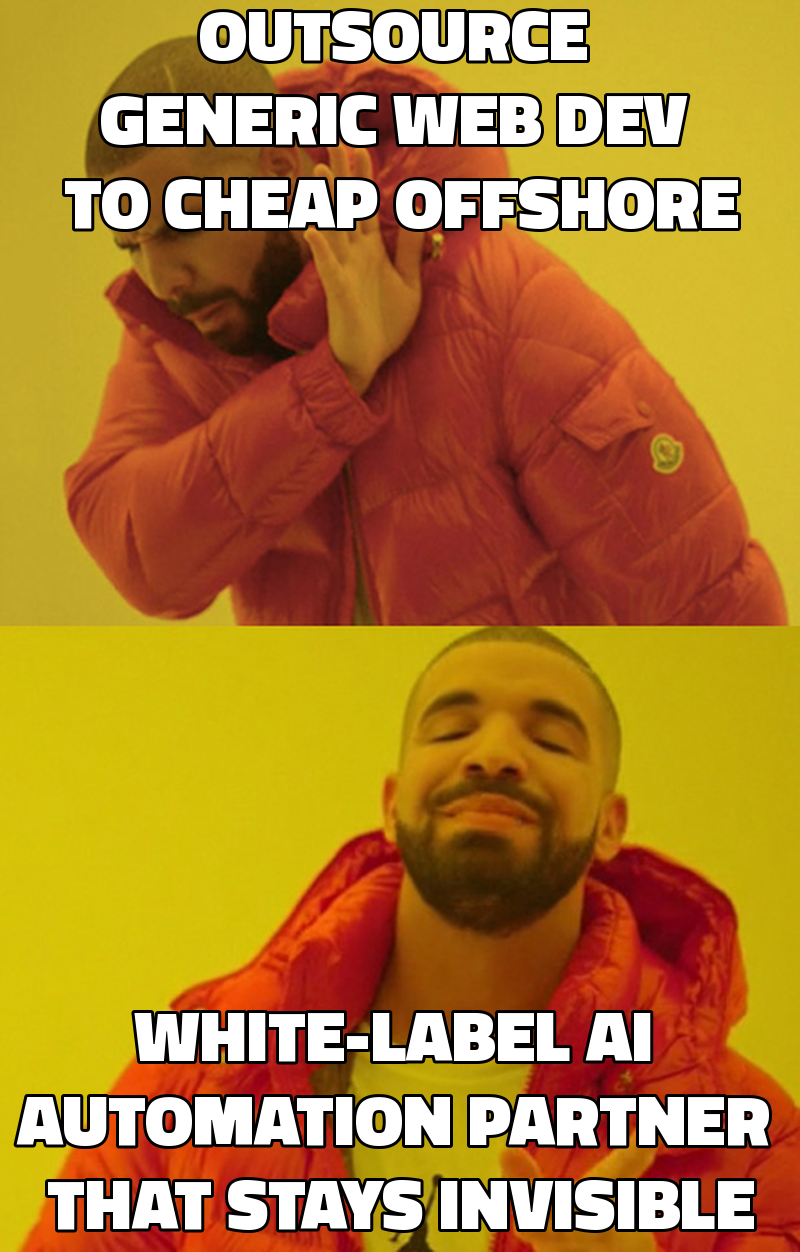
Which agency client segments profit most from AI automation?
Agencies that serve small and medium businesses (SMBs) in the US, UK and Australia frequently encounter requests for custom AI tools that no-code platforms cannot fulfil. The following table breaks down the four most lucrative niches, typical project size, and why they command high margins.
| Niche | Typical project size (USD) | Gross margin % | Why high margin |
|---|---|---|---|
| E-commerce personalization | 2,500-4,000 | 55 | Replaces manual product tagging, drives 10% higher conversion rates, and requires only a few integration points. |
| Local business chatbots | 1,200-2,200 | 65 | Low development effort, high perceived value, and easy upsell to voice assistants. |
| SaaS onboarding automation | 3,500-5,000 | 60 | Reduces churn for the SaaS client, creates a natural retainer for ongoing tweaks. |
| Content-generation pipelines | 1,500-2,500 (monthly) | 70 | Subscription model, minimal support after initial setup, leverages large-language models that have low per-token cost. |
Why these niches outperform generic web development?
A 2023 Gartner report noted that AI-driven automation revenue grew 23% YoY, outpacing traditional software services by 12 points. Agencies that sell generic web sites often compete on price, whereas AI automation projects sell on outcome – faster sales cycles, measurable ROI, and reduced human labor. The white-label partner can charge a wholesale rate of 50-70% of the agency’s bill, preserving a healthy spread while the agency keeps the client face.
How to position a white-label AI automation partner to agencies
- Speak the agency’s language – emphasise “you keep the client and the margin, we stay invisible.”
- Offer a pilot – a fixed-scope, $2,500 build delivered in 3 weeks proves capability without large upfront risk.
- Show a dashboard – a shared project view (Google Sheet or simple Notion board) builds transparency without a custom SaaS.
- Bundle retainer options – after the pilot, propose a $1,500/month retainer for 15-20 hours of overflow work.
- Provide NDA and non-circumvent clauses – reassure agencies that their brand will not be exposed.
What does the financial model look like for a partner?
The deal shape is a wholesale white-label arrangement. Agencies bill their clients at market rates (typically $4,000-$7,000 for a mid-size AI build). Synthisia receives 55% of that bill on average, translating to $2,200-$3,850 per project. The minimum floor of $1,500 ensures the delivery overhead is covered. Retainers add predictable monthly cash flow and deepen the relationship.
| Metric | Agency bill (USD) | Synthisia wholesale (USD) | Agency net margin |
|---|---|---|---|
| Small chatbot | 2,000 | 1,100 | 45 |
| E-commerce personalization | 4,000 | 2,200 | 45 |
| SaaS onboarding | 5,500 | 3,000 | 45 |
| Content pipeline (monthly) | 1,500 | 900 | 40 |
How to find agencies that need a white-label AI partner
- Case study gap – a portfolio shows a platform or automation deliverable but the team page lists no engineers.
- Public partner callout – “We partner with developers” statements on the About page.
- Job post for contract dev – signals overflow demand without a payroll commitment.
- Recent win of a larger client – indicates an imminent need for custom tooling.
Use the 10-second site test: open the Services page; if “development” is absent, the agency is a prime target.
What are the common objections and how to answer them?
| Objection | Response |
|---|---|
| “We don’t want our clients to know we outsource.” | Emphasise the white-label model, NDA, and the fact that the brand stays front-and-center on all deliverables. |
| “We can’t afford a dev partner.” | Show the pilot cost ($2,500) versus the lost revenue from turning away a $5,000 project – a net gain of $2,500 in the first month. |
| “We already have a freelancer.” | Ask what they can’t do – AI-specific automation, voice integration, or scaling. Highlight Synthisia’s proven track record with RouteMate, a production SaaS built in 4 months. |
| “We worry about quality.” | Provide case studies, a 48-hour demo prototype, and a SLA that guarantees delivery within the agreed timeline. |
What ongoing services can turn a one-off build into recurring revenue?
- Automation monitoring – $300/month for alerting and minor tweaks.
- Model fine-tuning – $500/month to keep LLM outputs aligned with brand tone.
- Feature backlog grooming – $200/month for quarterly roadmap sessions.
- Integration updates – $400/month for API version changes. These services are packaged as a retainer, increasing the lifetime value of each agency partner.
How to scale the partnership without losing reliability?
- Cap active partners at 8-10 agencies to maintain low concurrency.
- Standardise pilot templates – a reusable scope, checklist, and delivery timeline.
- Automate internal workflows – use Zapier or Make to route tickets, status updates, and invoices.
- Track KPIs – average project turnaround (days), pilot conversion rate, and monthly recurring revenue per partner.
“Reliability beats price every time for agencies that have built a brand on client trust.” – (source: McKinsey, 2023 agency survey)
Frequently asked questions
How much does a pilot cost and how long does it take?
A pilot is a fixed-scope build priced between $2,000 and $3,000 and delivered in 2-4 weeks. It includes a prototype, testing, and a hand-over document, giving the agency a sellable asset quickly.
What if the agency already has a dev partner?
Ask what the current partner cannot do. Most dev shops lack deep AI model integration, voice assistants, or rapid LLM fine-tuning. Position the AI automation layer as a complementary service.
Can the agency brand the deliverable fully?
Yes. All code, UI, and documentation are delivered under the agency’s branding. Synthisia never appears in client-facing materials unless the agency chooses to co-brand.
What SLA do you offer?
We guarantee delivery within the agreed timeline (±2 days) and a 99% uptime for any hosted AI endpoint we manage. Bugs are resolved within 48 hours.
How do you handle data privacy for EU clients?
We comply with GDPR by storing data in EU-region cloud instances (Azure UK South or AWS EU-West) and signing a Data Processing Addendum as part of the contract.
Is there a minimum monthly retainer?
The first retainer begins after a successful pilot and is $1,500 per month, covering up to 20 dev hours for ongoing tweaks, monitoring, and new feature requests.
What technology stack do you use for AI automation?
We build on Python, FastAPI, LangChain, and OpenAI or Anthropic APIs for LLMs. Front-end components use React or Vue, and we host on AWS or GCP with CI/CD pipelines for rapid iteration.
How quickly can you start after the agency signs the agreement?
On average we begin work within 3 business days after the pilot contract is signed and the initial deposit is received.
AI automation
Have something to build?
Tell us what you're trying to ship. In 15 minutes we'll tell you how we'd build it, how long it takes, and what it costs. No pitch deck, no pressure.