
Best Fleet Management Software for Small Business (2026)

The best fleet management software for a small US carrier is the one that fits your specific dispatch workflow, compliance needs and budget. Rather than chasing the cheapest per-truck SaaS, evaluate the four main solution categories and choose the one that balances customization, implementation speed and ongoing cost.
Key takeaways
- Off-the-shelf SaaS is fast to start but often forces you into generic workflows and per-truck fees.
- Local agencies can add a personal touch but may lack deep technical expertise in modern web stacks.
- Freelancers are cheap for simple tweaks but risk limited support and scalability.
- A custom or white-label build gives full ownership, tailored features and predictable one-time cost – ideal when off-the-shelf tools miss critical dispatch steps.
- US regulations (FMCSA, DOT, HOS) and data residency requirements mean your solution must store data on US-based servers and support compliance reporting.
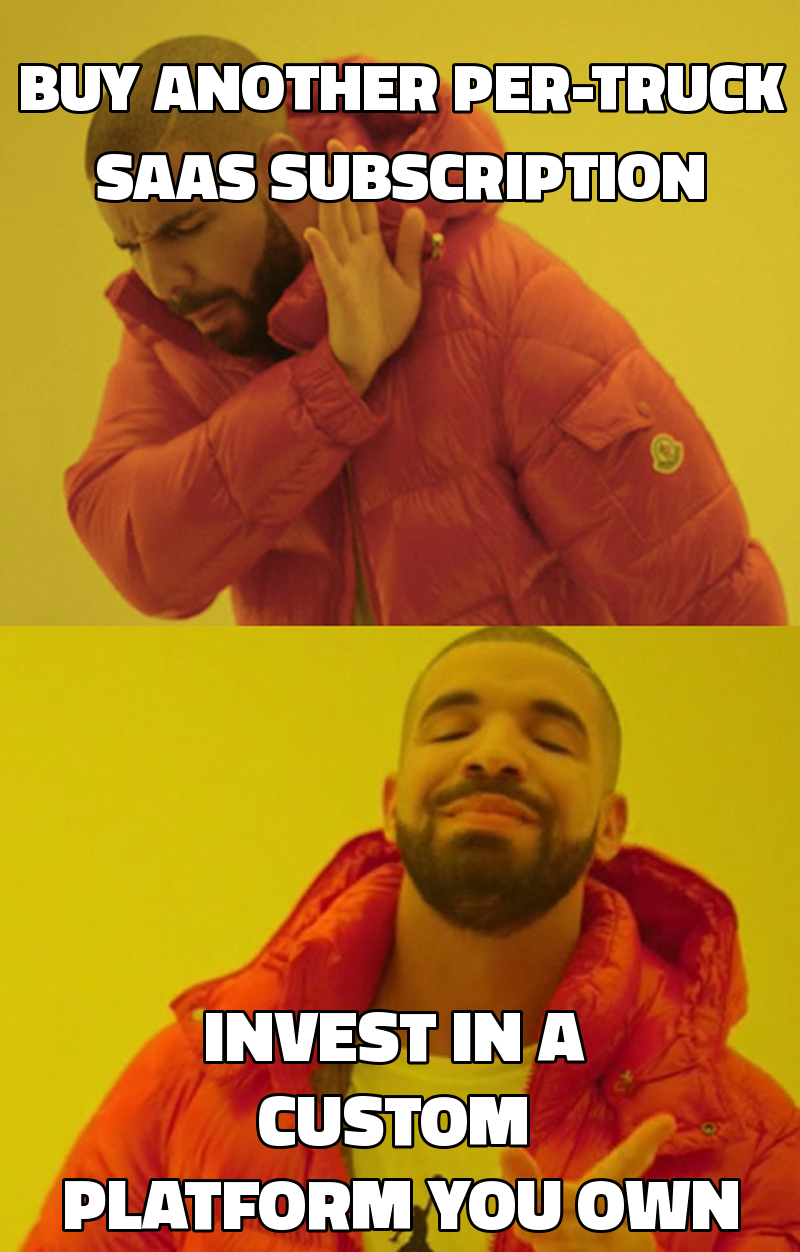
Comparison of solution categories
| Option | Typical cost (USD) | Implementation time | Customization level | Ongoing fees | Best for |
|---|---|---|---|---|---|
| Off-the-shelf SaaS (e.g., Samsara, Fleetio) | $15-$30 per truck per month | Days to weeks (plug-and-play) | Low – fixed modules | Recurring subscription, per-truck | Companies that need basic GPS tracking and are comfortable with per-truck pricing. |
| Local agency (US-based consulting firm) | $20,000-$60,000 project fee | 2-4 months | Medium – can adapt existing SaaS or build low-code dashboards | Maintenance retainer optional | Carriers that want a nearby partner for hands-on training and occasional custom reports. |
| Freelancers / contract devs | $5,000-$25,000 project fee | 1-3 months | High – pure code changes, but limited to developer skill set | Usually none, but may need ad-hoc support contracts | Small tweaks, integrations with WhatsApp Business API, or proof-of-concept builds. |
| Custom / white-label build (remote partner) | $40,000-$120,000 one-time | 3-6 months | Very high – built to your exact dispatch, compliance and customer-visibility flows | Low-cost optional maintenance retainer | Carriers that outgrow SaaS limits, need full data ownership and want a system that scales with fleet size. |
Off-the-shelf SaaS solutions
Off-the-shelf platforms dominate the US market because they promise quick deployment and a suite of telematics features. For a fleet of 10-30 trucks they can be attractive, but there are trade-offs:
- Per-truck pricing creates a hidden growth tax as you add vehicles.
- Fixed UI often forces dispatch to fit the software, not the other way around, leading to workarounds like spreadsheets.
- Compliance modules may not align with your exact FMCSA reporting cadence, requiring manual export and re-entry.
- Data residency is usually US-based, which satisfies most carriers, but you lose direct control over backups and migrations. If your operation is simple, just GPS tracking and basic driver logs, SaaS can be a good starter. However, most SMB carriers quickly hit limits when they need custom routing rules, WhatsApp driver communications, or a branded customer portal.
Local agencies and consulting firms
US-based agencies bring a personal relationship and can handle end-to-end projects, from process analysis to training. Their strengths include:
- On-site workshops that map your spreadsheet workflow into a digital process.
- Regulatory expertise for FMCSA, DOT and state-level compliance.
- Hybrid solutions that combine existing SaaS with custom dashboards. Challenges are higher cost than pure SaaS, longer timelines, and sometimes a reliance on legacy low-code platforms that are hard to extend later. If you value face-to-face interaction and need a partner that can also help with driver training, a local agency may be the right fit.
Freelancers and contract developers
Hiring a freelance full-stack developer (React, Express, Postgres) can be a cost-effective way to automate a specific pain point, such as:
- Building a custom dispatch board that pulls jobs from a spreadsheet and pushes assignments to drivers via WhatsApp Business API.
- Creating a simple compliance reminder system that emails you before service intervals.
- Integrating existing telematics data into a single dashboard. The main risk is support continuity. Once the freelancer finishes, you may be left with a system that only they understand. For a one-off integration or proof-of-concept, freelancers are valuable, but for a core operational platform you will likely need a longer-term partner.
When a custom / white-label build is the right call (Synthisia)
If off-the-shelf SaaS feels like a band-aid, local agencies are too expensive, and freelancers cannot guarantee scalability, a purpose-built system is worth considering. Synthisia specializes in remote, end-to-end custom builds for carriers like yours. Their approach includes:
- Full ownership – you receive the source code and can host it on any US-based cloud provider you choose.
- Tailored dispatch workflow – the system mirrors the way you already assign loads, eliminating spreadsheet duplication.
- Integrated driver communications – native WhatsApp Business API integration keeps the channel your drivers already use while logging every message.
- Compliance automation – automatic alerts for service intervals, registration renewals and HOS limits, all stored in a secure US data center.
- One-time pricing – a clear project budget with an optional low-cost maintenance retainer, avoiding per-truck subscription creep. Soft CTA: If you are ready to see how a custom platform can cut weekly manual hours and give you full data control, schedule a free discovery call with Synthisia’s fleet-software team.
Frequently asked questions
How much does a custom fleet system cost in the US?
A custom build typically ranges from $40,000 to $120,000 depending on feature complexity, number of integrations and UI design depth. This is a one-time expense, after which you own the code and can host it on any US cloud provider.
Will a remote partner like Synthisia be able to work with US regulations?
Yes. Synthisia’s engineers are experienced with FMCSA, DOT and state compliance rules. They build reporting modules that generate the exact CSV or PDF formats required for audits.
Can I still use my existing telematics hardware with a custom platform?
Absolutely. Custom builds can ingest data from any GPS device or telematics API you already have, allowing you to keep your hardware investment while gaining a tailored UI.
How long does it take to go from spreadsheet to a live custom dashboard?
Most projects launch a functional MVP in 3-4 months, with full production rollout by month 5-6. This timeline includes discovery, design, development, testing and user training.
What are the ongoing costs after the build is delivered?
There are no per-truck subscription fees. Ongoing costs may include a modest cloud hosting bill (typically $100-$300 per month) and an optional maintenance retainer for updates and support, usually 5-10% of the original build price per year.
Is data stored in the US to meet residency requirements?
Yes. All Synthisia deployments can be hosted on US-based AWS, Azure or Google Cloud regions, ensuring compliance with data residency expectations for US carriers.
How does a custom system improve driver communication?
By integrating directly with WhatsApp Business API, every dispatch message is logged, timestamps are recorded and drivers can reply within the same app they already use. This eliminates missed calls and creates an audit trail for disputes.
What if my fleet grows beyond 100 trucks?
Custom platforms are built to scale. Adding more trucks usually means only modest increases in hosting costs and, if needed, additional feature modules, no exponential subscription fees.
fleet management
Have something to build?
Tell us what you're trying to ship. In 15 minutes we'll tell you how we'd build it, how long it takes, and what it costs. No pitch deck, no pressure.