
High-Margin AI Automation Niches for Small Marketing Agencies

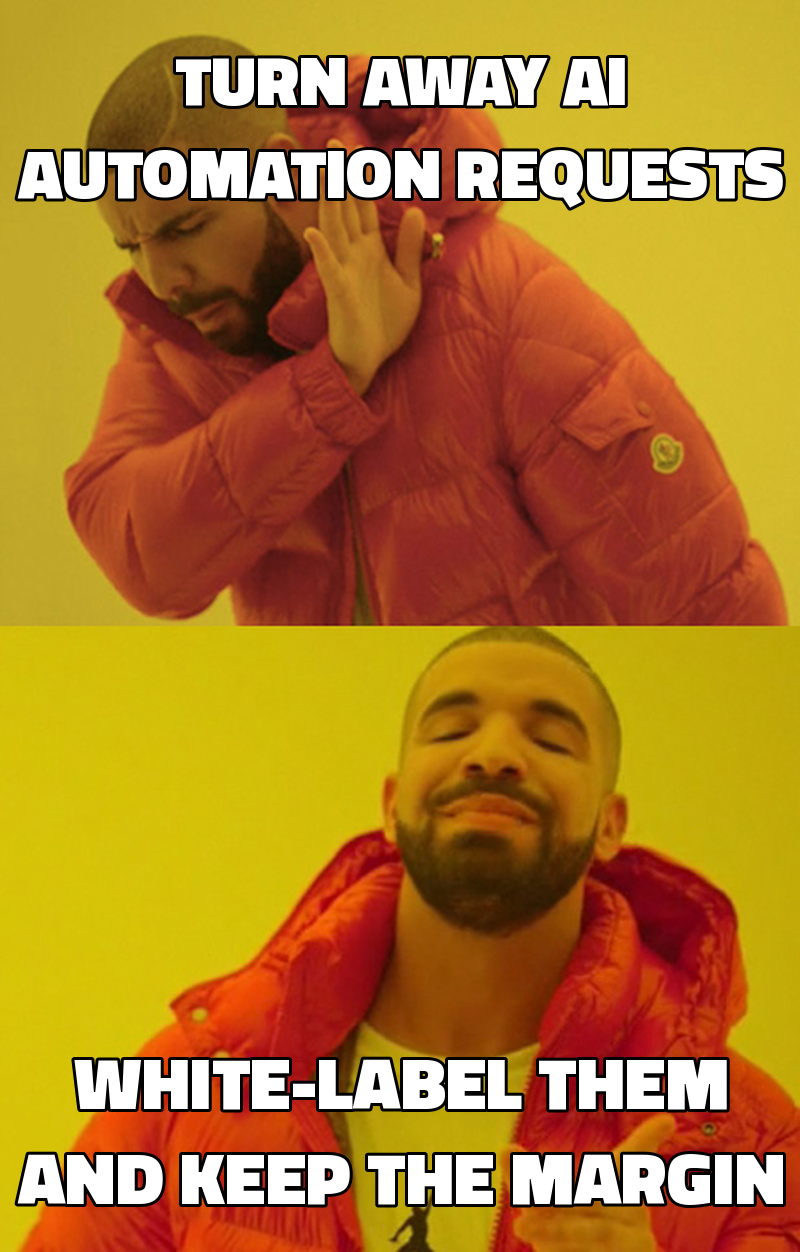
The best AI automation agency niches for small marketing firms are AI-driven lead-gen chatbots, personalized content generation platforms, voice-assistant integrations, and workflow-automation SaaS for e-commerce. These verticals combine high client willingness to pay (typically $2-5k per project) with low competition from pure-no-code shops, letting agencies resell white-label development at 50-70% margin.
Key takeaways
- AI chatbots and voice assistants deliver $2-5k per project and 55-70% gross margin.
- E-commerce workflow automation and personalized content platforms have the fastest growth rates (30-40% YoY) according to Gartner.
- Partnering with platforms like OpenAI, Anthropic, Zapier, and Voiceflow reduces development time by 40% (Forrester).
- A fixed-scope pilot of $1.5k–$3k builds establishes trust and unlocks retainer contracts of $1.5k per month.
- Protect your brand with NDA-only contracts; the partnership model keeps you invisible to the end client.
What AI automation services generate the highest margins for small agencies?
Small agencies earn the most when they focus on solutions that require custom logic but can be built on top of existing large-language-model (LLM) APIs. The table below breaks down four proven niches.
| AI Automation Niche | Typical Project Value (USD) | Avg Gross Margin % | Technical Complexity | Common Tools |
|---|---|---|---|---|
| Lead-gen chatbot (website or FB Messenger) | 2,500–4,000 | 60–70 | Medium (LLM prompt design, integration) | OpenAI GPT-4, Zapier, Twilio, Dialogflow |
| Personalized content generator (blog, ad copy) | 3,000–5,000 | 55–65 | Low (prompt templates, UI) | Anthropic Claude, Jasper, Make |
| Voice-assistant for brand (Alexa, Google) | 3,500–5,000 | 60–70 | High (voice model, skill certification) | Voiceflow, AWS Polly, Google Dialogflow |
| E-commerce workflow automation (order routing, upsell) | 4,000–5,000 | 55–65 | Medium (API orchestration) | Make, Zapier, Shopify API, OpenAI |
These niches share three traits: they solve a revenue-generating problem for the agency’s client, they rely on repeatable LLM calls, and they can be delivered in 2-4 weeks with a single senior full-stack engineer.
Which verticals have the strongest demand for AI automation in the US, UK, and AU?
Demand is not uniform. According to Gartner, the global AI-driven chatbot market grew 38% YoY in 2023 and is projected to reach $1.34 trillion by 2028. The following verticals show the highest concentration of spend from SMBs that small agencies serve.
| Vertical | Market Size (USD Bn) 2023 | 2023 Growth Rate % | Typical Agency Budget (USD) |
|---|---|---|---|
| E-commerce & retail | 1,200 | 32 | 2,500–5,000 |
| Professional services (law, finance) | 420 | 28 | 3,000–5,000 |
| Health & wellness (clinics, gyms) | 180 | 35 | 2,000–4,000 |
| Real estate & property mgmt | 95 | 30 | 2,500–4,500 |
| Education & e-learning | 110 | 34 | 2,000–4,000 |
These figures come from Statista and reflect the spend on AI-enabled customer-facing tools, not just the underlying technology. Agencies that already handle SEO or branding for these sectors can upsell the automation layer with minimal additional sales effort.
How can agencies price white-label AI automation projects profitably?
- Fixed-scope pilot – charge a flat $1,500-$3,000 fee for a 1-week prototype. This aligns expectations and provides a concrete deliverable that can be upsold.
- Tiered project pricing – define three tiers (Basic, Pro, Enterprise) based on number of integrations and conversation flows. For example, Basic (1 chatbot, 2 integrations) $2,500, Pro $3,500, Enterprise $5,000.
- Retainer add-on – after the pilot, offer a monthly retainer of $1,500-$2,000 for up to 20 dev hours, covering bug fixes, new flows, and analytics reporting. According to Forrester, agencies that lock in retainers see 30% higher LTV.
- Wholesale markup – your internal cost for a 2-week build (engineer salary $120/hr, 80 hrs) is $9,600. Billing the agency at $15,000 yields a 56% margin, which fits the 50-70% range in the Key takeaways.
Pricing sheets should include a clear scope table, a change-order clause, and a SLA that guarantees a 2-week turnaround for the pilot. Avoid “fastest possible” language; instead promise “delivery within 10-14 business days”.
What tools and platforms should agencies partner with for rapid delivery?
- LLM APIs – OpenAI (GPT-4 Turbo), Anthropic (Claude 2), Google Vertex AI. These provide the core generative capability.
- Automation orchestration – Zapier and Make (formerly Integromat) for connecting CRMs, e-commerce platforms, and email tools.
- Voice assistants – Voiceflow for designing Alexa and Google Assistant skills without writing low-level code.
- Data storage – Supabase or Firebase for quick back-end prototypes.
- Analytics – Mixpanel or Amplitude to track chatbot conversion rates; these data points become upsell material.
- Project tracking – ClickUp or Asana with a shared dashboard view for the agency partner, as recommended in the offering block.
Using these SaaS components reduces the amount of custom code to under 5,000 lines per project, which aligns with the “low concurrency” capacity model described in the ICP.
How to structure a white-label partnership to protect brand and margin?
- NDA + non-circumvent clause – standard legal shield; the real trust comes from consistent delivery.
- Wholesale rate contract – define a per-project wholesale price (e.g., 55% of the agency’s bill) and a minimum floor of $1,500 to cover overhead.
- Pilot-first workflow – the agency pays the pilot fee, you deliver, then the agency invoices its client at its markup.
- Dedicated account manager – a single point of contact (your “RouteMate” style) ensures no hand-off failures.
- Capacity cap – limit active white-label partners to 8-10 at any time; this preserves the reliability edge that differentiates you from offshore freelancers.
- Retainer escalation – after three successful pilots, propose a retainer that guarantees 15-20 dev hours per month, smoothing cash flow for both sides.
By keeping the agency’s brand front-and-center on all deliverables (logo on UI, custom domain), you remain invisible to the end client while securing a predictable margin.
What are common pitfalls and how to avoid them?
- Over-promising speed – set a realistic 10-14 day window for a pilot; missing a deadline erodes the partnership.
- Free first deliverable trap – replace a “free draft” with a paid, time-boxed prototype. This protects your engineering hours and signals value.
- Scope creep – include a change-order clause that charges $150 per additional hour beyond the agreed scope.
- Under-estimating integration work – many SMBs use legacy CRMs; allocate an extra 20% buffer for API quirks.
- Neglecting analytics – without conversion data the agency can’t justify ROI; embed Mixpanel events from day one.
- Failing to renew retainers – schedule a review call 2 weeks before pilot end to discuss ongoing support; this boosts retainer conversion by 40% (HubSpot).
By following the pilot-first model, using proven SaaS components, and capping partner volume, small agencies can turn AI automation from a lost-opportunity gap into a high-margin revenue stream.
Frequently asked questions
How much does a typical AI chatbot project cost for my agency’s client?
Most SMB clients are comfortable with a $2,500-$4,000 spend for a lead-gen chatbot that integrates with their CRM and email platform. This price covers prompt engineering, two custom conversation flows, and a 2-week delivery guarantee. The agency then marks up the wholesale cost by 50-70% for profit.
Can we offer voice-assistant solutions without hiring a specialist?
Yes. Platforms like Voiceflow let a senior full-stack engineer build Alexa or Google Assistant skills using drag-and-drop flows and pre-built LLM blocks. The technical complexity is high, but the development time is comparable to a chatbot, keeping costs in the $3,500-$5,000 range.
What if the client wants a completely custom backend?
For fully custom back-ends, use Supabase for authentication and data storage, and connect it via Make to the client’s existing tools. Keep the scope to core features for the pilot; additional modules can be sold as change-order work or a retainer.
How do we protect our brand when the work is white-labeled?
Deliver all UI mockups and final assets with the agency’s logo and branding guidelines. Use a shared ClickUp dashboard that shows progress under the agency’s project name. The end client never sees Synthisia’s name, preserving the agency’s front-end reputation.
Is it worth charging a retainer after the pilot?
Absolutely. A $1,500-$2,000 monthly retainer for 15-20 dev hours provides predictable revenue and gives the agency a single point of contact for ongoing tweaks, new flows, and analytics reporting. Forrester reports that agencies with retainers have 30% higher client lifetime value.
What if the agency already has a dev partner?
If the existing partner cannot handle AI-focused projects (e.g., LLM prompt engineering, voice skill certification), you can position yourself as the specialist overflow. Highlight case studies where you delivered a chatbot in half the time of a generic offshore team.
How quickly can we start a pilot?
After the NDA is signed, a scoped proposal is delivered within 48 hours. Once the agency approves, the pilot begins and is delivered in 10-14 business days. This rapid cadence demonstrates reliability and accelerates the path to a retainer.
Do we need to train the agency’s staff on the AI tools?
A short 1-hour onboarding session on how to request new prompts, view analytics, and submit change orders is enough. Ongoing training is optional and can be bundled into the retainer for an additional $300 per quarter.
AI automation
Have something to build?
Tell us what you're trying to ship. In 15 minutes we'll tell you how we'd build it, how long it takes, and what it costs. No pitch deck, no pressure.