
White-Label App Development Services: When to Outsource vs Build In-House

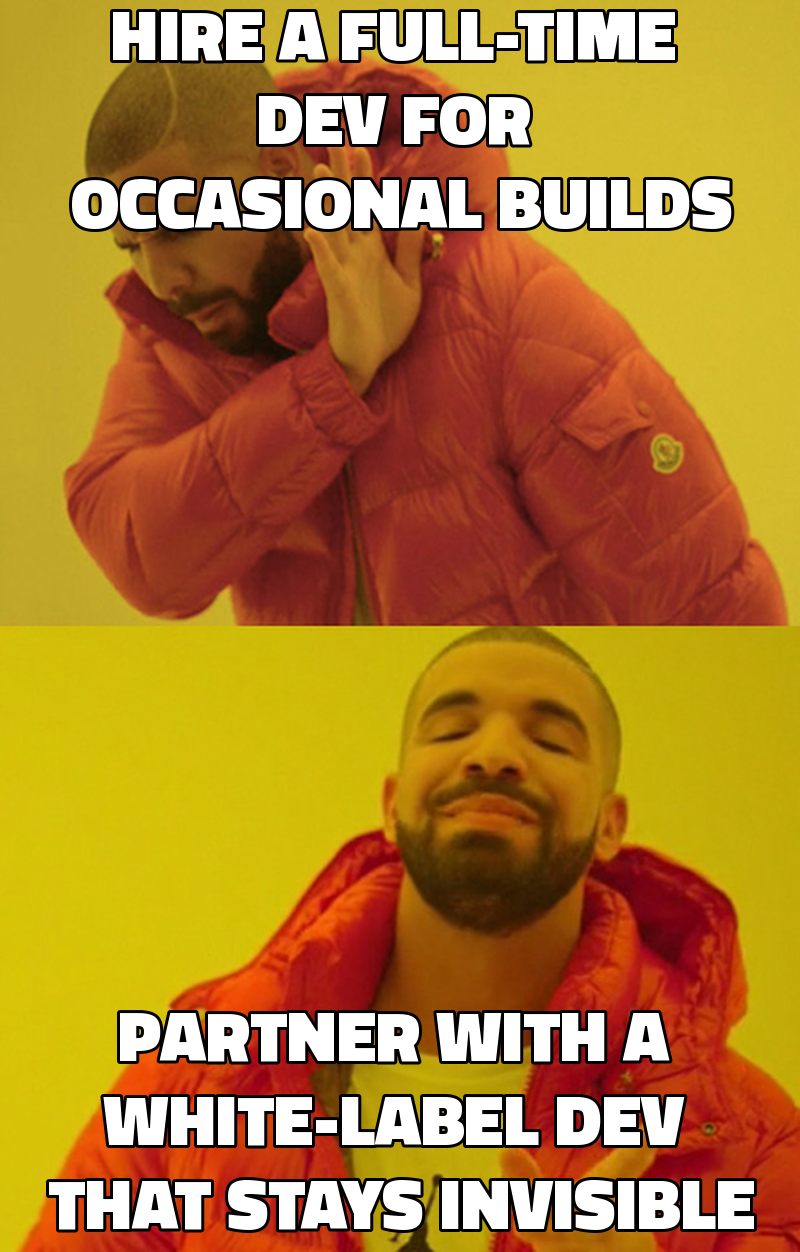
White-label app development services let agencies deliver custom mobile and web apps under their own brand without hiring developers. Use this model when you have sporadic, high-value builds, need AI or voice expertise, and want to keep margins while staying invisible to the client.
Key takeaways
- White-label partners handle end-to-end development, keeping your brand front-and-center and protecting client relationships.
- Build in-house only when project volume exceeds $10,000 per month and you need rapid iteration on core products.
- A fixed-scope pilot (typically $1,500-$5,000) de-risks the partnership and proves delivery speed.
- Agencies that outsource 30-40% of their dev work see a 22% increase in billable capacity (Clutch, 2023).
- Choose partners with proven AI/voice automation experience; RouteMate is a live production SaaS built by Synthisia.
- Evaluate cost, control, and cultural fit using the comparison tables below.
What is white-label app development and why does it matter for small agencies?
White-label app development is a B2B service where a development studio builds software products that are branded and sold by another company, in this case, a marketing, SEO, or branding agency. The agency retains the client relationship, sets the price, and pays the developer a wholesale rate. This model solves three core pain points for agencies with 5-15 staff:
- Lost revenue – turning away requests for custom apps, AI chatbots, or voice assistants.
- Brand risk – fearing clients will discover the work is outsourced.
- Resource constraints – hiring a full-time engineer costs $120k-$150k annually in the US/UK/AU, which is unsustainable for sporadic demand.
According to a 2022 Deloitte survey, 48% of boutique agencies cite “lack of technical talent” as the top barrier to expanding service offerings. White-label partners fill that gap while preserving the agency’s brand promise.
When should you outsource to a white-label partner?
| Situation | Typical Agency Profile | Recommended Action |
|---|---|---|
| Infrequent, high-value builds (>$5k) | 5-10 staff, <3 dev projects per month | Start with a fixed-scope pilot, then move to a retainer |
| Need for AI/voice automation that no-code tools can’t handle | Agencies focused on SEO/branding, using Webflow or WordPress | Partner with a specialist like Synthisia (AI automation, custom back-ends) |
| Existing freelancer or offshore partner missed deadlines | 8-12 staff, recent client complaints | Switch to a vetted white-label partner with NDA & non-circumvent clauses |
| Rapid client win that requires a mobile app within 4-6 weeks | 5-15 staff, high client churn risk | Use white-label partner’s accelerated delivery band (e.g., 3-4 weeks for MVP) |
Key signals that you are ready to outsource:
- Your services page lists no development offering, yet case studies show app or platform work.
- You’ve posted a short-term dev job on Upwork or LinkedIn.
- A new client has asked for a custom chatbot or voice-enabled tool.
If any of these apply, a white-label partner can turn a lost opportunity into billable revenue.
When is building an in-house dev team the right move?
| Metric | Threshold for In-House Hire |
|---|---|
| Monthly dev spend | > $10,000 consistently |
| Number of concurrent builds | > 3–4 medium-size projects |
| Strategic product ownership | Need to iterate daily on a proprietary SaaS |
| Talent market access | Ability to recruit senior engineers locally |
In-house development shines when the agency owns the product roadmap (e.g., a SaaS platform sold to multiple clients) and requires rapid, iterative releases. The overhead includes salaries, benefits, equipment, and management – roughly $150k per senior engineer in the US, $90k in the UK, and $70k in Australia (Glassdoor, 2024). For agencies that only need occasional custom builds, the ROI of hiring in-house rarely breaks even within the first 12 months.
Cost comparison: white-label partner vs. in-house hire
| Cost Component | White-Label Partner (per project) | In-House Engineer (annual) |
|---|---|---|
| Base rate | $50-$80 per hour (wholesale) | $120,000-$150,000 salary |
| Overhead (legal, NDA, admin) | $200-$500 per contract | $20,000-$30,000 (HR, benefits) |
| Ramp-up time | 1-2 weeks for pilot | 4-8 weeks for recruitment & onboarding |
| Flexibility | Scale up/down per project | Fixed capacity, idle time when no projects |
| Risk of turnover | Low – partner absorbs risk | High – you bear replacement cost |
| Quality guarantee | SLA with delivery milestones | Direct control, but depends on hiring quality |
A typical $3,000 app build costs $2,400-$2,800 with a white-label partner after wholesale discount, leaving the agency 50-70% margin. An in-house engineer would need to bill at least $250 per hour to cover salary and overhead, which is rarely achievable for boutique agencies.
Risk & benefit matrix for white-label vs. in-house
| Factor | White-Label | In-House |
|---|---|---|
| Control over code | Limited to partner’s process, but NDA protects IP | Full ownership, but requires internal QA |
| Speed of delivery | Fixed turnaround bands (e.g., 3-4 weeks for MVP) | Potentially faster after ramp-up, but limited by internal bandwidth |
| Scalability | Add more pilots, no hiring friction | Hiring bottleneck, salary caps |
| Brand exposure risk | Low – partner stays invisible under NDA | None – you own the brand |
| Financial risk | Pay-per-project, no fixed payroll | Fixed salary, risk of under-utilization |
| Expertise depth | Access to AI, voice, custom backend specialists | Depends on team skill set |
How to evaluate a white-label development partner
- Portfolio relevance – Look for AI automation, voice assistants, and full-stack SaaS examples. Synthisia’s RouteMate is a production-grade SaaS built for an agency partner.
- Process transparency – Request a shared project dashboard (e.g., ClickUp or Monday.com view) that shows status, milestones, and QA checkpoints.
- Fixed-scope pilot – Insist on a $1,500-$5,000 pilot with a clear definition of deliverables and timeline.
- Legal safeguards – NDA and non-circumvent clause are table-stakes; verify they won’t poach your client.
- Capacity limits – Choose partners who cap active agency accounts (Synthisia limits to 12 partners) to guarantee reliability.
- Support SLA – Minimum 24-hour response for critical bugs; 48-hour for non-critical.
Step-by-step onboarding checklist
| Step | Action | Owner |
|---|---|---|
| 1 | Run the 10-second site test (services page) | Business Development |
| 2 | Qualify via Volume, Budget, Live-Need gates | SDR |
| 3 | Schedule pilot discovery call – confirm scope, timeline, pricing | Account Executive |
| 4 | Sign NDA + Non-Circumvent Agreement | Legal |
| 5 | Define pilot deliverables in a Statement of Work (SOW) | Project Manager |
| 6 | Set up shared dashboard (ClickUp) with client-visible view | Delivery Lead |
| 7 | Execute pilot, collect feedback, iterate | Development Team |
| 8 | Review pilot ROI – margin, client satisfaction, repeat potential | Founder |
| 9 | Convert to retainer (15-20 hrs/month) if pilot succeeds | Finance |
Real-world example: Turning a lost chatbot request into $4,800 revenue
Background – A UK-based branding agency (8 staff) lost a $6k chatbot project because they only used Zapier and could not deliver natural-language AI. Action – Synthisia offered a $2,500 pilot to build a prototype using Dialogflow and a custom Node.js backend. The prototype was delivered in 3 weeks, meeting the client’s MVP expectations. Result – The agency signed a $4,800 full build contract, kept the client relationship, and added a $1,200 monthly retainer for ongoing bot updates. Margin after wholesale cost was 58%. Takeaway – A low-risk pilot can convert a “no-go” into a profitable, repeatable stream.
ROI calculator for a typical agency partner
Assumptions:
- Average project size: $3,500
- Wholesale cost to partner: 55% of bill (≈ $1,925)
- Projects per month: 2 (sporadic demand)
- Retainer after 3 pilots: $1,800/month for 15 hrs support
Monthly Gross Margin = (2 × $3,500) – (2 × $1,925) = $2,150 Annualized Margin with Retainer = ($2,150 × 12) + ($1,800 × 12) = $46,200 Break-even – After 4 pilots (≈ $10k revenue) the partnership pays for itself, and the retainer provides recurring profit.
Frequently asked questions
How does a white-label partnership protect my agency’s brand?
The developer signs an NDA and a non-circumvent clause, works under your brand, and never mentions their own name to the client. All deliverables are handed over with your logo, and you retain full control of client communication.
What if the white-label partner misses a deadline?
Choose partners with a Service Level Agreement (SLA) that includes penalties for missed milestones (e.g., 5% discount per week). The shared dashboard provides real-time visibility, allowing you to intervene early.
Can I negotiate a fixed price for ongoing development?
Yes. After a successful pilot, many partners move to a retainer model (e.g., $1,500-$2,000 per month for 15-20 dev hours). This gives you predictable costs and priority access to capacity.
How do I compare multiple white-label providers?
Use a side-by-side matrix focusing on portfolio relevance, hourly rate, SLA terms, pilot cost, and capacity limits. The table below illustrates a quick comparison.
| Provider | AI/Voice Expertise | Wholesale Rate | Pilot Cost | Capacity Limit |
|---|---|---|---|---|
| Synthisia | High (RouteMate, Dialogflow) | $55/hr | $2,000 | 12 active agencies |
| DevPartnerX | Medium (no voice) | $45/hr | $1,500 | 20 active agencies |
| CodeCraft Studios | Low (basic web) | $40/hr | $1,200 | 30 active agencies |
What legal documents are essential before starting?
At minimum you need a Mutual NDA, a Non-Circumvent Agreement, and a Statement of Work that defines scope, deliverables, timeline, and payment terms. These protect IP and ensure the partner cannot approach your client directly.
How long does a typical pilot take?
For a scoped MVP or automation, 3-4 weeks is common. The timeline includes discovery (2-3 days), design (1-2 weeks), development (1-2 weeks), and QA (2-3 days). Fixed timelines are crucial for agency billing cycles.
Is there a risk of the partner becoming a hidden competitor?
Reputable white-label studios focus on being invisible and do not market directly to your client base. The non-circumvent clause legally prevents them from soliciting your clients for a defined period (usually 12 months).
Conclusion: Choose the path that aligns with volume, expertise, and risk tolerance
If your agency’s dev demand is irregular, requires advanced AI or voice capabilities, and you cannot justify a $120k salary, a white-label partner like Synthisia offers a low-risk, high-margin solution. Conversely, if you have a steady stream of $10k-plus projects, own a proprietary SaaS, or need daily iteration, building an in-house team becomes financially sensible. Use the comparison tables, pilot framework, and ROI calculator to make an evidence-based decision that protects your brand, keeps margins healthy, and lets you say “yes” to more client requests.
white-label
Have something to build?
Tell us what you're trying to ship. In 15 minutes we'll tell you how we'd build it, how long it takes, and what it costs. No pitch deck, no pressure.