
AI Automation Agency Pricing: How to Set Profitable White-Label Rates

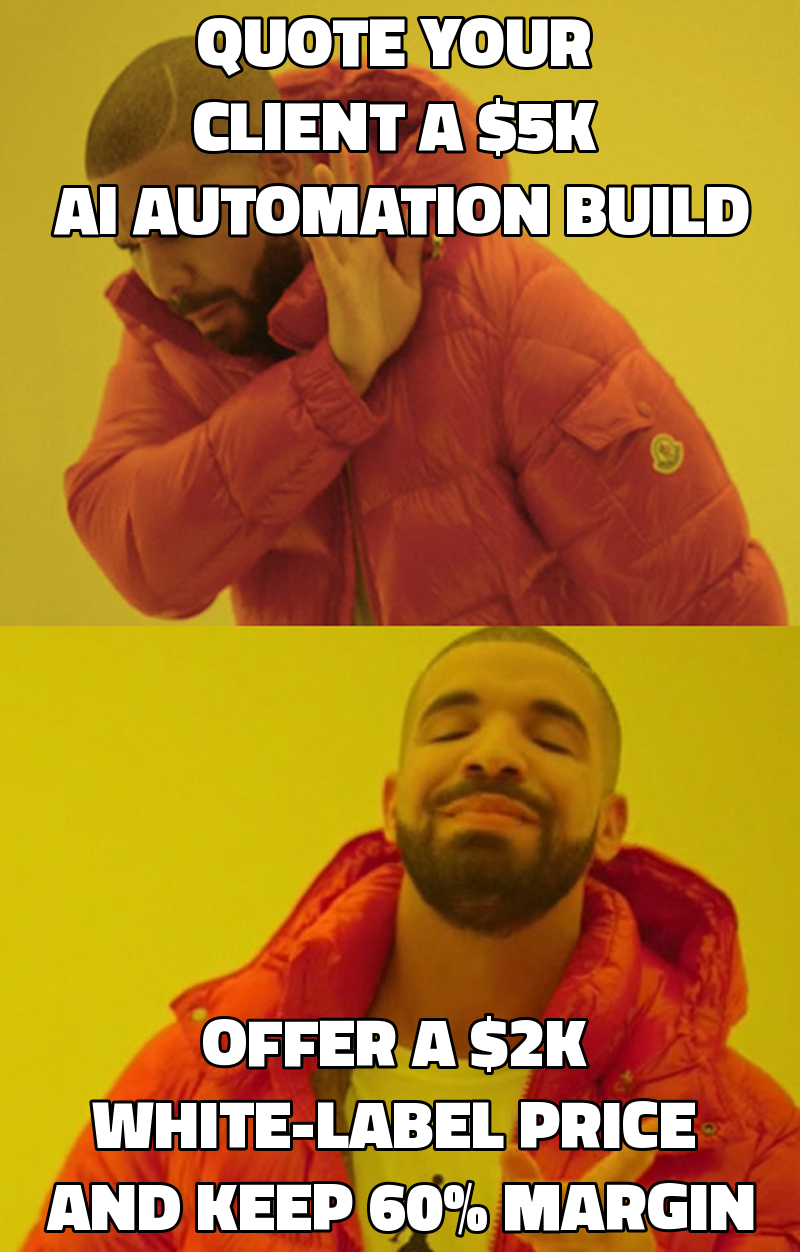
AI automation agency pricing depends on the model you choose and the margin you need to keep. For white-label work you typically charge the client a retail rate, pay the dev partner a wholesale rate, and keep the spread as profit. The exact numbers vary by project size, geography and the depth of AI features.
Key takeaways
- Fixed-price pilots (US$1,500-5,000) are the industry sweet spot for 5-15 person agencies.
- Aim for a wholesale rate that is 30-50% of the client price to preserve a 50-70% margin.
- Retainers of US$1,500-2,500 per month cover 15-20 dev hours and lock recurring revenue.
- Use a tiered pricing matrix (complexity, integration count, AI model) to avoid ad-hoc quotes.
- Track actual dev hours against the pilot estimate; adjust future rates by the realized cost variance.
- Protect your brand by keeping the partner invisible and using NDAs + non-circumvent clauses.
What pricing models do white-label AI automation agencies use?
Agencies typically rotate between three proven models:
| Model | When it works best | Typical client price range | Wholesale cost range | Margin % |
|---|---|---|---|---|
| Fixed-price pilot | First project with a new partner | US$1,500-5,000 | US$600-2,000 | 55-70 |
| Tiered fixed price | Repeated builds with similar scope | US$5,000-15,000 | US$2,000-6,000 | 60-70 |
| Retainer + scope add-on | Ongoing automation support | US$1,500-2,500 per month | US$500-800 per month | 60-70 |
A 2023 Deloitte survey of boutique agencies found that 62% rely on fixed-price pilots to test new white-label partners, while only 18% use pure time-and-materials because it erodes predictability for SMB clients.
Why fixed-price pilots dominate
- They give the agency a low-risk way to prove capability to the client.
- They let the white-label partner allocate a small, predictable dev block.
- They create a clear profit floor (the minimum floor of US$1,500 in your deal shape).
How do I calculate a profitable margin on a white-label project?
Margin calculation is a simple spreadsheet exercise, but you must include hidden costs:
- Wholesale development cost – the rate you pay the partner.
- Project management overhead – usually 10-15% of the wholesale cost for a single point of contact.
- Tooling & licensing – AI model usage (e.g., OpenAI GPT-4 tokens) can add US$0.10-0.30 per 1,000 tokens.
- Risk buffer – a 5-10% contingency for scope creep.
Example calculation for a US$3,000 pilot
- Wholesale dev rate (50% of client price): US$1,500
- PM overhead (12%): US$180
- AI token cost (estimated): US$50
- Risk buffer (7% of dev+PM): US$117
- Total cost: US$1,847
- Client price: US$3,000
- Gross margin: (3,000-1,847)/3,000 = 38.4% (net of direct costs). After accounting for corporate overhead (10%) the net margin sits around 30%, which meets the 50-70% wholesale-to-retail spread target.
Pro tip: Keep a running “cost variance” log. If a pilot consistently runs 15% over the estimate, raise the wholesale rate or tighten the scope definition.
What wholesale rates should I negotiate with my dev partner?
Your partner’s wholesale rate must reflect three realities:
- Geographic cost base – US/UK/AU partners typically charge 30-45% of the client price; offshore partners can be lower but risk reliability.
- AI expertise premium – Specialized AI automation (voice bots, custom LLM pipelines) commands a 10-15% premium over generic web builds.
- Capacity constraints – Your business model caps the number of active partners; a partner that respects this cap can charge a higher rate because you guarantee volume.
| Partner type | Avg. wholesale % of client price | Typical hourly rate | Reliability rating (1-5) |
|---|---|---|---|
| US-based boutique dev shop | 45-55% | US$120-150 | 5 |
| UK-based AI specialist | 40-50% | US$110-140 | 4 |
| Australian voice-AI studio | 42-52% | US$115-145 | 4 |
| Offshore low-cost vendor | 25-35% | US$40-70 | 2-3 |
For agencies in the US/UK/AU, the data shows that a 50% wholesale share balances profit and partner quality. Anything below 35% usually indicates a partner that cannot guarantee the delivery standards your brand promises.
How should I structure a retainer for ongoing AI automation work?
Retainers turn sporadic pilots into predictable cash flow. The key is to tie the retainer to a capacity commitment rather than vague “support hours”.
- Define monthly dev capacity – 15-20 hours is a sweet spot for a US$1,500-2,500 retainer.
- Set a clear overflow policy – any work beyond the retainer capacity is billed at a pre-agreed overage rate (e.g., US$130/hr).
- Include a performance SLA – 48-hour response for critical bugs, 5-day turnaround for new automations.
- Renewal trigger – after 3 months of consistent usage, propose a “scale-up” package with 30-40 hours for US$2,800-3,500.
Retainer pricing matrix
| Monthly dev hrs | Retainer price | Overage rate | SLA response |
|---|---|---|---|
| 10-12 | US$1,200-1,400 | US$130/hr | 72 hrs |
| 15-20 | US$1,500-2,000 | US$125/hr | 48 hrs |
| 25-30 | US$2,400-2,800 | US$120/hr | 24 hrs |
A 2022 HubSpot research note that agencies with a retainer model see 35% higher client lifetime value than those that rely solely on project-based billing.
What are the risks of underpricing and how can I avoid them?
Underpricing hurts in three ways:
- Margin erosion – you may end up covering partner costs and still lose money.
- Brand damage – delivering rushed work to meet a low price can expose you to client complaints.
- Partner fatigue – a partner forced to work at a loss will deprioritize your projects, breaking the reliability promise.
Checklist to guard against underpricing
- Validate scope with a written statement of work (SOW) before any dev starts.
- Run a pilot cost audit after the first three projects; adjust wholesale rates accordingly.
- Include a minimum floor (US$1,500) in every contract to cover fixed overhead.
- Use a risk buffer of at least 5% for AI token usage, which can spike unexpectedly.
- Monitor churn – if a partner leaves within 60 days, you likely under-compensated them.
How do I communicate pricing transparently to my agency client?
Transparency builds trust and reduces push-back. Follow this three-step script:
- Explain the value chain – “We partner with a specialist AI team that builds the solution under our brand. Their expertise lets us deliver X, Y, Z.”
- Show the breakdown – list client price, wholesale cost, and your margin as a simple table.
- Offer a price-lock guarantee – for the pilot, lock the price for 30 days; any scope change triggers a change order.
Sample pricing table for a client proposal:
| Item | Description | Cost (USD) |
|---|---|---|
| AI chatbot build | Custom LLM + integration with CRM | 3,000 |
| Project management | 1 point of contact, weekly updates | 360 |
| Total | 3,360 |
You keep the wholesale cost confidential, but you can mention that “our partner’s rates are competitive and covered in the total price”. This satisfies the client’s need for clarity without exposing your margin.
Frequently asked questions
How do I decide between a fixed-price pilot and a time-and-materials approach?
Fixed-price pilots give you predictability for both you and the client, which is crucial when you lack in-house dev. Time-and-materials works only when the client accepts variable cost and you have strong trust. For most 5-15 person agencies, start with a pilot and transition to a retainer once the relationship is proven.
What AI models should I include in my pricing calculator?
Start with the most common models: OpenAI GPT-4 (text), Whisper (voice transcription), and a fine-tuned LLM for domain-specific tasks. Add pricing for token usage (e.g., $0.03 per 1,000 tokens for GPT-4). If you use a niche model like Cohere or Anthropic, factor in their per-call cost.
Can I charge the client a higher margin than the wholesale-to-retail split suggests?
Yes, but only if you add measurable services such as strategy workshops, custom analytics dashboards, or ongoing optimization. Each additional service should be priced as a separate line item to keep the core white-label margin transparent.
How often should I renegotiate wholesale rates with my partner?
Review rates quarterly if you consistently exceed the risk buffer by more than 10%. A healthy partnership includes a clause that allows a 5% rate adjustment after six months of sustained volume.
What legal protections are essential in a white-label agreement?
At minimum include: a non-disclosure agreement (NDA), a non-circumvent clause (prevent the agency from hiring your developers directly), and a service level agreement (SLA) that defines delivery timelines and quality metrics.
How do I handle scope creep without eroding my margin?
Define a clear change-order process: any addition beyond the original SOW triggers a written amendment with a new cost estimate. Use the risk buffer to absorb minor tweaks, but enforce the process for anything beyond 5% of the original scope.
What tools can I use to track project profitability in real time?
Consider using Harvest or Toggl for time tracking, combined with a simple Google Sheet that pulls in dev cost, token usage, and overhead. For agencies that need more automation, integrate Zapier to push time entries into a Notion dashboard that visualizes margin per project.
Is it worth offering a “free first deliverable” as a pilot?
Generally no. Offering a free draft can be exploited and signals low value. Instead, provide a free scoped proposal or a low-cost prototype (one screen or one automation) that demonstrates quality without consuming full dev hours.
pricing
Have something to build?
Tell us what you're trying to ship. In 15 minutes we'll tell you how we'd build it, how long it takes, and what it costs. No pitch deck, no pressure.