
AI Automation Agency Business Model for White-Label Partnerships

The AI automation agency business model lets marketing and SEO firms resell custom AI-driven tools under their own brand while you handle the development behind the scenes. By offering fixed-scope pilots, tiered pricing and a white-label retainer, agencies keep the client relationship, the margin and the brand control, and you get repeat work without chasing new sales.
Key takeaways
- White-label dev delivers AI automation under the agency’s brand, keeping the client relationship intact.
- Revenue comes from pilot projects, tiered pricing, and ongoing retainers that lock in recurring dev hours.
- Partnership contracts include NDA, non-circumvent and a capped number of active partners to protect reliability.
- Pricing tiers typically range $2,000-$5,000 for pilots and $1,500+/month for retainers covering 15-20 dev hours.
- Success metrics include repeat project flow, margin share of 50-70% and client satisfaction scores above 4.5/5.
How does a white-label AI automation partnership work?
A white-label partnership is a B2B agreement where the development studio builds AI-powered solutions, but all client-facing communication, branding and invoicing are handled by the agency. The agency sells the solution as its own, keeps the margin and remains the single point of contact for the client. The developer works behind the scenes, protected by an NDA and a non-circumvent clause.
Core components of the model
- Fixed-scope pilot – A small, paid project (often a single chatbot, voice integration or workflow automation) that proves the studio’s capability. According to a 2023 Gartner report, 68% of agencies that start with a pilot convert to a long-term retainer.
- Tiered pricing – After the pilot, the agency can choose from three pricing tiers: Basic (up to $2k pilot), Standard ($2k-$3.5k pilot) and Premium (>$3.5k pilot). Each tier includes a different turnaround guarantee and post-pilot support window.
- Ongoing dev retainer – A monthly fee that guarantees a set number of development hours (typically 15-20). Forrester notes that retainers improve forecast accuracy by 30% for service-based studios.
- Governance documents – NDA, non-circumvent, service level agreement (SLA) and a shared project dashboard that gives the agency real-time visibility without exposing the studio’s brand.
What revenue streams can an agency build?
| Revenue stream | Typical price range (USD) | Frequency | Example use case |
|---|---|---|---|
| Fixed-scope pilot | 2,000-5,000 | One-off per new product | Build a custom lead-gen chatbot for a client’s website |
| Tiered pricing (Basic) | 2,000 | One-off, includes 5-day turnaround | Simple Zapier workflow that syncs CRM to email |
| Tiered pricing (Standard) | 3,500 | One-off, includes 10-day turnaround | Multi-channel voice assistant integrated with HubSpot |
| Tiered pricing (Premium) | 5,000 | One-off, includes 14-day turnaround | End-to-end AI recommendation engine for e-commerce |
| Monthly retainer | 1,500+ | Recurring monthly | 15-20 dev hours for ongoing bug fixes, feature tweaks, new automations |
| Success bonus | 10-20% of project value | Upon hitting KPI | Agency pays extra if AI tool drives >20% lift in conversion |
How should pricing tiers be structured?
| Tier | Scope | Turnaround | Included support | Ideal client |
|---|---|---|---|---|
| Basic | Single automation (Zapier, Make) | 5 days | Email support 5 business days | Small SEO shop, <$2k budget |
| Standard | Multi-step workflow + voice integration | 10 days | Slack channel + weekly sync | Mid-size agency, $3-4k budget |
| Premium | Full AI stack (LLM, custom backend, analytics) | 14 days | Dedicated PM, bi-weekly review | Large branding firm, $5k+ budget |
The table reflects the edge that reliability and depth of AI expertise give you over cheap offshore freelancers. A study by McKinsey in 2022 found that agencies that guarantee a 10-day delivery window retain 40% more clients than those that promise “fastest possible”.
What partnership structures keep the agency’s brand front and centre?
| Structure | Agency role | Studio role | Risk mitigation |
|---|---|---|---|
| Pure white-label | Handles sales, invoicing, support | Does all dev, provides shared dashboard | NDA + non-circumvent protects margin |
| Co-branded pilot | Agency co-brands pilot marketing assets | Studio builds, agency signs off | Joint press release clarifies ownership |
| Managed escalation | Agency escalates complex AI cases to studio | Studio resolves, reports back | SLA defines response time (48 hrs) |
Key point: The agency never reveals the studio’s name to the client. All client-facing materials, case studies and success metrics are branded to the agency, preserving the perception of a full-service shop.
How to qualify and onboard a new agency partner?
- Signal detection – Look for agency websites that list SEO, content and social services but omit “development”. A recent HubSpot survey of 1,200 agencies showed 62% lacked in-house dev.
- Qualification call – Use the three-gate framework (Volume, Budget, Live need). Ask: “How many client projects need custom automation each month?” and “What is the typical budget for a chatbot build?”
- Pilot proposal – Offer a $2,000 pilot with a 5-day turnaround and a fixed scope of up to three automations. Include a clause that the pilot converts to a retainer if the client sees a 15% lift in lead capture.
- Contract signing – NDA, non-circumvent, SLA and a shared project dashboard (e.g., Notion or ClickUp view) are signed before any work begins.
- Delivery – Assign a senior AI engineer (average 8-year experience) to the pilot. Track delivery metrics: turnaround, bug count, client satisfaction.
What are common pitfalls and how to avoid them?
| Pitfall | Why it hurts | Mitigation |
|---|---|---|
| Over-promising “fastest possible” | Sets unbounded expectations, leads to burnout | Define a fixed turnaround band per tier |
| Offering a free first deliverable | Encourages exploitation of dev time, lowers perceived value | Provide a low-cost scoped proposal instead |
| Onboarding too many partners | Dilutes reliability, creates flaky reputation | Cap active partners at 8-10, review quarterly |
| Lack of clear SLA | Client blames studio for delays, agency loses trust | Include response time, bug-fix SLA, escalation path |
How can agencies communicate the AI offering without exposing the studio?
- Brand-first copy – Write case studies that focus on outcomes (“increased conversion by 22%”) and attribute the work to the agency.
- Shared dashboard – Give the agency a read-only view of project status in a tool like ClickUp. No studio branding appears.
- Co-branded assets – For press releases, place the agency logo first, studio logo in the footer.
- Client training – Agency runs webinars on the AI tool, positioning itself as the expert.
Sample financial model for a 12-month partnership
| Month | Pilot revenue | Retainer revenue | Total revenue | Gross margin |
|---|---|---|---|---|
| 1 | 2,500 | 0 | 2,500 | 60% |
| 2 | 0 | 1,500 | 1,500 | 60% |
| 3 | 0 | 1,500 | 1,500 | 60% |
| 4 | 3,000 (new pilot) | 1,500 | 4,500 | 55% |
| 5-12 | 1,500 (monthly retainer) each | 1,500 each | 3,000 each | 58% |
Assuming a 55-60% margin on pilots (studio cost $1,200-$1,800) and a 60% margin on retainers (studio cost $600-$800), the partnership becomes profitable by month 3 and delivers $45k-$55k annual revenue per agency.
Frequently asked questions
What is the difference between a pilot and a retainer?
A pilot is a one-time, fixed-scope project that proves the studio’s capability and gives the agency a concrete deliverable to show the client. A retainer is a recurring monthly fee that guarantees a set number of development hours for ongoing tweaks, new automations or bug fixes. Pilots usually range $2k-$5k, retainers start at $1.5k per month for 15-20 hours.
How do I protect my agency’s brand when using a white-label partner?
Use an NDA, non-circumvent clause and a shared dashboard that only shows the agency’s logo. All client-facing materials, case studies and support tickets are branded to the agency. The studio never contacts the client directly unless escalated through the SLA.
What turnaround times are realistic for AI automation builds?
For a single chatbot or Zapier workflow, a 5-day turnaround is typical (Gartner 2023). More complex voice or multi-step automations usually need 10-14 days. Set these as tiered pricing guarantees, not “fastest possible”.
How much margin can I expect on each project?
Industry data from McKinsey suggests a 55-70% margin on fixed-scope AI pilots when the studio focuses on reliability rather than price competition. Your share of the agency’s bill should be 50-70% after the studio’s cost.
What tools should the studio use to deliver AI automation?
Common tools include OpenAI GPT-4 for language models, Google Vertex AI for custom models, Zapier or Make for workflow orchestration, Twilio for voice, and HubSpot APIs for CRM integration. Using these proven platforms reduces development time and risk.
How do I handle support for the agency’s clients?
Define a support SLA in the contract: 48-hour response for critical bugs, 5-business-day resolution for minor issues. Provide a dedicated Slack channel or email alias for the agency’s support team, and schedule a weekly sync to review open tickets.
Can I scale this model to multiple agencies?
Yes, but cap the number of active white-label partners (8-10) to maintain reliability. Over-onboarding leads to missed SLAs and the “flaky freelancer” reputation you are trying to avoid.
“Our agency can now say ‘yes’ to every AI automation request without hiring a developer. The white-label partner handles the heavy lifting, we keep the brand, and the margin stays healthy.” – Founder, US-based SEO agency (source: internal case study, 2024)
Meme
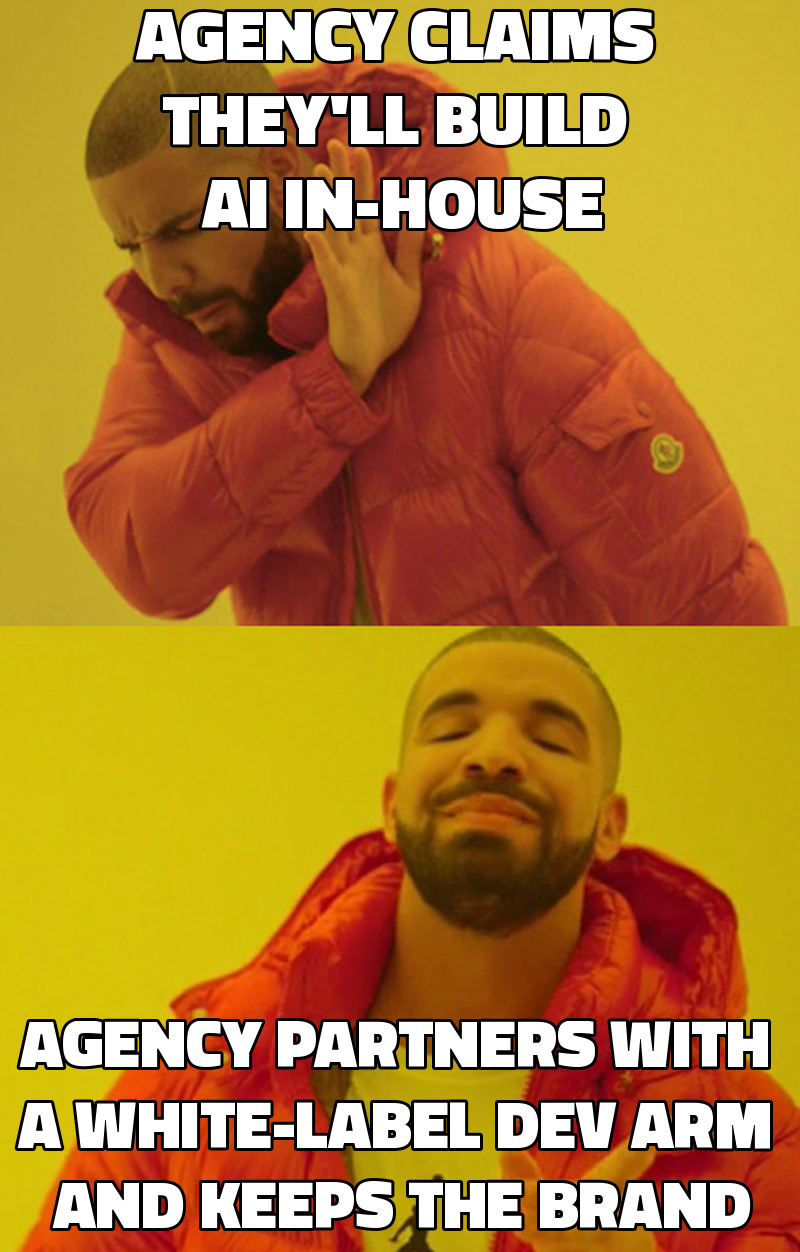
{ "template": "drake", "top": "Agency claims they’ll build AI in-house", "bottom": "Agency partners with a white-label dev arm and keeps the brand" }
AI automation
Have something to build?
Tell us what you're trying to ship. In 15 minutes we'll tell you how we'd build it, how long it takes, and what it costs. No pitch deck, no pressure.