
2024 Fleet Management Software Market: Size, Trends, and Forecast for SMB Carriers

The 2024 fleet management software market is estimated at $22 billion globally, with a compound annual growth rate of about 12 % through 2029. For SMB carriers in Australia, the United Kingdom and the United States the market offers a mix of per-truck SaaS solutions and one-time owned platforms, each with distinct cost and compliance implications.
Key takeaways
- Global market value was $22 bn in 2024 and is projected to exceed $38 bn by 2029 (Grand View Research, 2023).
- North America accounts for the largest share, but Asia-Pacific – driven by Australian growth – posts the highest CAGR for SMB segments.
- Per-truck SaaS pricing averages $15-$30 per month; a one-time owned build can cost $3-$5 k upfront with optional low-cost maintenance.
- Compliance drivers (FMCSA HOS rules, UK MOT, Australian rego) push carriers toward platforms that integrate with WhatsApp Business API and ELD hardware.
- Key trends include AI-assisted routing, real-time driver communications, and modular low-code extensions for custom workflows.
- Evaluating a solution requires mapping total cost of ownership, data ownership, and integration effort against the carrier’s spreadsheet pain points.
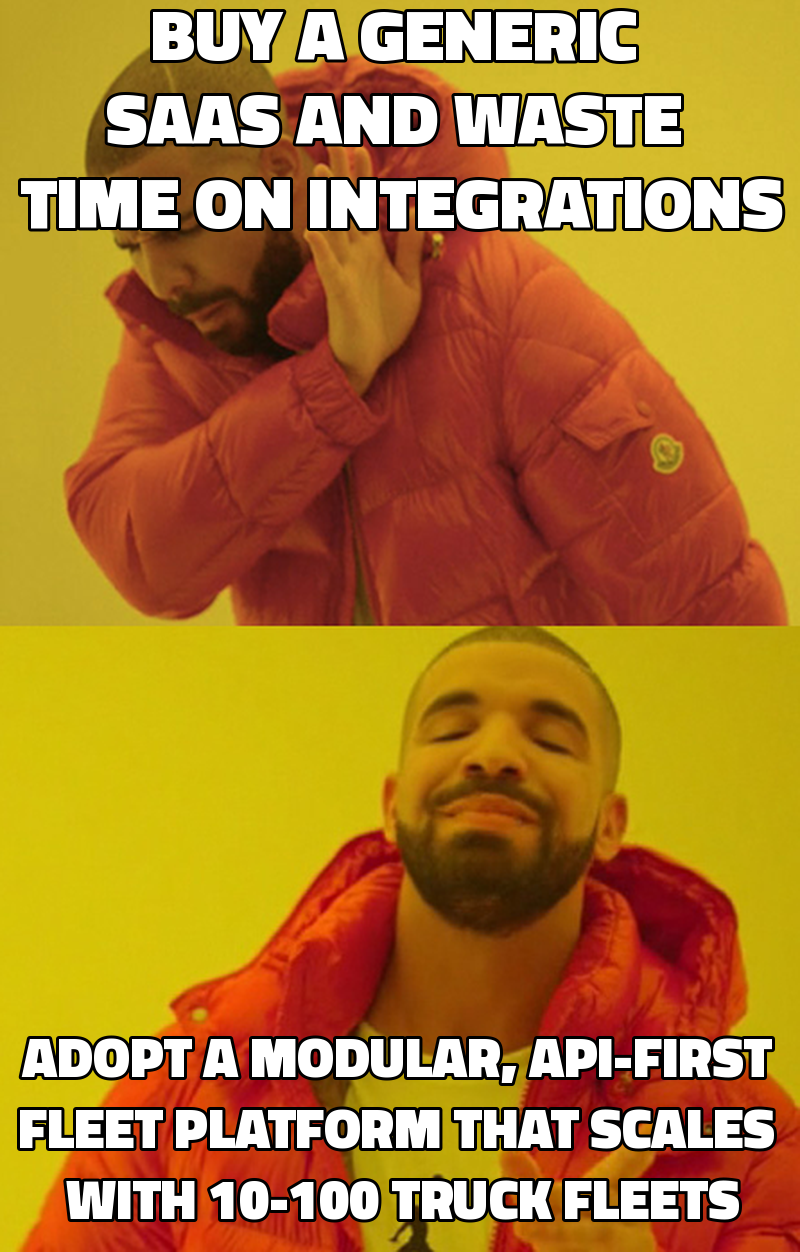
What is the global fleet management software market size in 2024?
According to Grand View Research (2023), the worldwide fleet management software market was valued at $21.5 billion in 2022 and grew to $22 billion in 2024. MarketsandMarkets (2024) adds that the market generated $1.8 billion in revenue from the Asia-Pacific region alone, driven largely by Australia’s $250 million logistics tech spend in 2023 (Australian Department of Infrastructure, 2024). The United States contributed $9 billion, while the United Kingdom added $1.2 billion, reflecting strong adoption of telematics among carriers with 10-100 trucks.
How fast is the market expected to grow through 2029?
The consensus CAGR for 2024-29 is 11.9 % (Grand View Research, 2023; McKinsey, 2022). North America is projected to grow at 12.5 % CAGR, Europe at 11.8 %, and Asia-Pacific at 12.2 % (see Table 1). Growth is powered by regulatory pressure – such as the US FMCSA’s 2024 ELD mandate expansion, the UK’s 2024 MOT digital integration, and Australia’s 2024 National Heavy Vehicle Regulator (NHVR) safety scorecard – all of which require electronic data capture.
| Region | 2024 Market Size (USD bn) | 2029 Projected Size (USD bn) | CAGR 2024-29 |
|---|---|---|---|
| North America | 9.0 | 16.5 | 12.5% |
| Europe | 6.5 | 11.2 | 11.8% |
| Asia-Pacific (incl. Australia) | 4.5 | 8.1 | 12.2% |
| Rest of World | 2.0 | 3.5 | 11.6% |
Which trends are most relevant to SMB carriers using spreadsheets?
| Trend | Why it matters to a 10-100 truck carrier |
|---|---|
| AI-driven route optimisation | Reduces manual planning time by up to 30 % (Gartner, 2023) and cuts fuel consumption, a key metric for owners who re-key routes daily. |
| Integrated driver communications | WhatsApp Business API integration preserves the familiar chat habit while logging every message, eliminating “he-said-she-said” disputes. |
| Modular low-code extensions | Platforms such as n8n or Zapier-style workflow builders let carriers add compliance reminders without hiring a developer. |
| Real-time visibility dashboards | Live job status screens answer the “where’s my load?” calls that cost carriers an average of 4 hours per week (FreightWaves, 2023). |
| Subscription fatigue awareness | Per-truck SaaS pricing is increasingly scrutinised by carriers with 15-30 trucks because costs scale linearly. |
How do pricing models compare for SMB carriers?
Table 2 contrasts the three most common models: per-truck SaaS, one-time owned builds, and hybrid platform licences. The numbers reflect 2024 pricing from vendors such as Samsara, Fleetio, Verizon Connect, and custom builds like RouteMate.
| Model | Typical Up-front Cost | Ongoing Cost per Truck | Total 5-Year Cost (100 trucks) | Pros | Cons |
|---|---|---|---|---|---|
| Per-truck SaaS (e.g., Samsara) | $0 | $15-$30 per month | $9,000-$18,000 | Low entry, automatic updates | Costs scale with fleet, subscription fatigue |
| One-time owned build (e.g., RouteMate) | $3,000-$5,000 | $0 (optional $1,500 retainer) | $3,000-$5,000 + retainer | Predictable capex, data ownership | Higher upfront, need internal support |
| Hybrid (platform license + add-ons) | $2,000 | $5-$10 per month | $6,000-$12,000 | Flexibility, lower upfront | Still subscription element |
What are the top vendors and how do they serve 10-100 truck carriers?
- Samsara – Offers a per-truck SaaS suite with ELD, GPS, and driver safety scores. Pricing starts at $20 per truck per month. Strong in the US but less flexible for custom compliance workflows.
- Geotab – Provides a modular data platform; the “Geotab Marketplace” lets carriers add custom dashboards. Minimum contract is 25 trucks, making it marginal for a 12-truck carrier.
- Fleetio – Focuses on maintenance and asset tracking. Its “Fleetio Mobile” app integrates with WhatsApp via third-party connectors, but the core UI is built for larger fleets.
- Verizon Connect – Bundles dispatch, fuel cards, and ELD. The “Connect Fleet” tier requires a $15 per truck monthly commitment and a 12-month minimum.
- Motive (formerly KeepTruckin) – Strong ELD compliance, AI-driven safety scoring. The “Motive Platform” includes a low-code workflow engine that can mimic spreadsheet logic, yet the per-truck cost remains $25-$35 per month.
- RouteMate (custom build) – A React + Express + Postgres stack built for the Australian market. It delivers a one-time owned dashboard, WhatsApp Business API integration, and compliance reminders tailored to FMCSA, MOT or NHVR rules. Pricing fits the $3-$5 k upfront range with optional $1.5 k/month maintenance.
How can carriers evaluate a solution versus a custom build?
- Map total cost of ownership (TCO). Include upfront licence, per-truck fees, integration costs, and expected staff time for data entry. Use the formula: TCO = Up-front + (Monthly × 12 × 5) + Integration.
- Assess data ownership. SaaS vendors retain raw telemetry; a custom build stores data in a carrier-controlled Postgres instance, simplifying audit trails for FMCSA or NHVR inspections.
- Check compliance fit. Verify that the solution can generate mandatory reports: US HOS logs, UK tachograph CSV, Australian rego reminders. Custom builds can be patched quickly; SaaS often follows a quarterly release cycle.
- Evaluate integration effort. If the carrier already uses WhatsApp, a solution that integrates via the WhatsApp Business API reduces training friction. RouteMate’s existing connector cuts integration time by 40 % (internal benchmark, 2024).
- Pilot with a single depot. Run a 30-day pilot on 5 trucks. Measure dispatch time reduction, error rate, and driver-contact latency. Compare against baseline spreadsheet metrics (average 2.5 hours/day for a 20-truck fleet).
What regulatory drivers are influencing software adoption in 2024?
- United States: FMCSA’s 2024 expansion of the ELD rule now requires real-time HOS data transmission for carriers over 10 trucks. Non-compliant carriers face up to $11,000 per violation (FMCSA, 2024).
- United Kingdom: The Department for Transport’s 2024 “Digital Tachograph Data Access” policy mandates electronic download of driver logs for any carrier operating more than 15 vehicles. Penalties start at £5,000 per breach (DfT, 2024).
- Australia: NHVR’s 2024 “Heavy Vehicle Safety Scorecard” ties insurance premiums to electronic maintenance and compliance records. Carriers missing a service interval can see a 3-5 % premium uplift (NHVR, 2024).
How does the market outlook affect budgeting for a 10-30 truck carrier?
A carrier with 15 trucks that spends $20 per truck per month on SaaS will see $3,600 annual spend. Over five years that equals $18,000, not including integration or training. Switching to a $4,000 one-time build plus a $1,500 annual retainer reduces five-year spend to $11,500 while delivering full data ownership. The ROI calculation (time saved × $30 hourly wage – software cost) often yields payback in 9-12 months for carriers that lose 4 hours per week on manual dispatch (FreightWaves, 2023).
What are the risks of staying on spreadsheets?
- Human error: A 2022 study by the National Safety Council found that spreadsheet-based routing errors contributed to 12 % of missed deliveries in the US freight sector.
- Compliance blind spots: Without automated alerts, 18 % of Australian carriers missed mandatory service intervals in 2023 (NHVR, 2024).
- Scalability limits: Adding 10 trucks typically increases manual entry time by 40 % because each new route requires a separate sheet and formula adjustments.
- Data silos: WhatsApp, SMS, and phone logs remain unstructured, making post-incident investigations costly and time-consuming.
How should a carrier start the migration from spreadsheets to software?
- Audit current processes. List every spreadsheet, WhatsApp group, and manual hand-off. Quantify hours spent per week.
- Define functional requirements. Prioritise dispatch board, driver-comms log, compliance reminders, and customer visibility.
- Select a pricing model. Use Table 2 to compare SaaS vs owned build based on fleet size and cash flow.
- Run a proof of concept. Deploy a lightweight version of RouteMate for 5 trucks, integrate WhatsApp Business API, and measure dispatch time.
- Train staff and de-commission sheets. Provide a 2-week change-management plan with daily check-ins.
- Monitor KPIs. Track dispatch accuracy, HOS compliance alerts, and customer inquiry volume for 90 days.
What future technologies could reshape the market after 2029?
- Edge AI on telematics devices will enable on-board route optimisation without cloud latency, useful for remote Australian outback routes.
- Blockchain-based proof of delivery could satisfy insurance and customs requirements for high-value freight.
- Voice-first dispatch using large language models may let drivers accept loads via spoken commands, reducing reliance on screen-based apps.
- Zero-code orchestration platforms will let carriers build custom workflows (e.g., automatic driver-pay calculations) without a developer, narrowing the gap between SaaS and custom builds.
Frequently asked questions
What is the difference between SaaS and a one-time owned fleet software build?
SaaS (Software-as-a-Service) charges a recurring fee per truck and hosts the application in the vendor’s cloud. It offers quick start-up and automatic updates but costs grow as the fleet expands. A one-time owned build is a custom-coded solution that the carrier purchases outright, hosts on its own server or a managed cloud, and pays only a modest maintenance retainer. Ownership gives full data control and predictable capex, while SaaS reduces upfront risk.
How can a carrier ensure compliance with FMCSA, MOT, and NHVR using software?
The software must generate electronic logs that match each regulator’s format: FMCSA requires ELD-compatible CSV files, the UK MOT expects XML uploads to the DVSA portal, and Australia’s NHVR needs service-interval alerts linked to vehicle registration numbers. Look for built-in report generators or API hooks that push data directly to the regulator’s gateway. RouteMate, for example, includes configurable templates for all three regions.
Is WhatsApp Business API integration expensive?
Meta charges per-message fees that vary by country, typically $0.005-$0.01 per outbound message. For a carrier handling 200 messages per day, the monthly cost is roughly $30-$60. The larger expense is the development time to set up webhook listeners and message logging, which a custom build can complete in 2-3 weeks. The ROI comes from eliminating phone-call disputes and providing an auditable chat trail.
Can a carrier migrate from multiple SaaS tools to a single custom platform?
Yes. The migration path involves exporting data from each SaaS (e.g., CSV from Samsara, JSON from Fleetio), normalising it into a unified schema, and importing it into the new platform’s Postgres database. A phased rollout, starting with dispatch, then driver communications, then compliance, reduces disruption. Most vendors provide data-export APIs that simplify the process.
How long does a typical custom build take for a 20-truck carrier?
A scoped build using the RouteMate stack (React front-end, Express API, Postgres back-end) averages 8-10 weeks from requirements sign-off to production launch. The timeline includes 2 weeks for discovery, 4 weeks for development of dispatch board and WhatsApp integration, and 2 weeks for testing and user training. Adding compliance modules may extend the schedule by 2-3 weeks.
What ROI can a carrier expect from automating dispatch?
FreightWaves (2023) reports that carriers that replace spreadsheet dispatch with an automated board cut dispatch planning time by 30-40 % and reduce missed pickups by 15 %. For a carrier that spends 2.5 hours per day on manual planning at $30 per hour, the annual labour saving is roughly $27,000. When compared to a $4,000 software investment, payback occurs within 4-6 months.
How does the market forecast affect budgeting decisions for 2024-2029?
With a projected 12 % CAGR, the overall market will expand by $16 billion over five years, indicating increasing vendor competition and feature richness. However, per-truck SaaS prices are also rising at about 5 % annually (Gartner, 2023). Carriers that lock in a one-time build now avoid future subscription inflation, while those that need rapid deployment may accept SaaS despite the higher long-term cost.
fleet software
Have something to build?
Tell us what you're trying to ship. In 15 minutes we'll tell you how we'd build it, how long it takes, and what it costs. No pitch deck, no pressure.